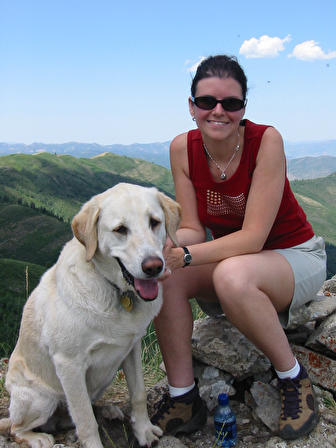
Below is a tribute to Jackson. I love you buddy.
Tuesday, November 09, 2004

Sunday, November 07, 2004
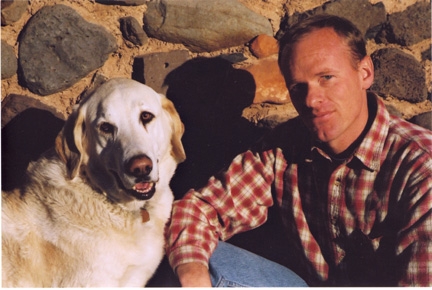
T. Jackson Powell:
The Greatest Dog in the World
If it wasn’t for David I may not have met him. Though my friend Briony offers another perspective: she says that we don’t pick our dogs, they pick us.
I think Briony is right, though I am eternally grateful for the role David played too.
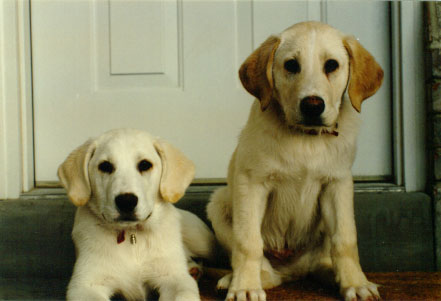
On Thanksgiving Day in 1996 a little puppy picked David and me as his new parents. He was just seven and a half weeks old. On that day we brought him home to our house in Lindon, Utah. We had about sixteen people over to celebrate Thanksgiving, which needless to say overwhelmed this little puppy who curled up in a corner and waited for the crowd to disburse.
The pup was born in Provo on October 16, 1996. His mother was a registered Great Pyrenees, though she was small for that breed so she may have been a mix. His father was a dog from a one night stand. Steve Hegerhorst, who had the mother and saw the father run off after doing the deed, said he was a Golden Retriever.
We named the pup T. Jackson Powell. I insisted that this was a puppy who was more than important enough to have a proper name. David came up with Jackson, after Jackson Hole, Wyoming. The T. was for Thanksgiving in honor of both the day Jackson entered our lives and the feeling we felt in having him join our family. Powell was after John Wesley Powell, the nineteenth century explorer and policy maker. Powell led the first expedition down the Colorado River in 1869. He created the Bureau of Ethnology which studied and documented the cultures of American Indians. He also was the head of the U.S. Geological Survey from 1881 to 1894.
Our little Jackson was a gorgeous puppy who only got better looking as he grew up.
We took him to puppy pre-school at our local Petsmart. He won the best in class award, beating out Donny Osmond’s Black Lab. We were so focused on our little guy that it took us three classes before we finally realized that yes that was the guy from television in our obedience class with us. We considered the Osmond puppy unruly.
Like John Wesley Powell, Jackson led an adventurous life--flying on airplanes and traveling tens of thousands of miles in cars, mostly our 1997 Subaru. He went on ferry’s, slept on sail boats, went motor-boating, and camping. He was a willing and eager explorer, as long as someone was close by--usually me. We spent many many hours hiking, mountain biking, and cross-country skiing. He spent over three years of his life living on three different farms (including a ranch) where he roamed with total freedom.
Jackson called four states home for nine months or more. These were Utah, Ohio, Virginia, and Arizona. He also visited at least twenty other states and the District of Columbia, as well as Canada. The stupidest move of his life was when he nearly leaped into the rushing water at the top of Niagara Falls, a move that could have also taken me with him either accidentally as I was holding his leash, or in desperation to save him. We had just parked the Subaru and walked toward the noise of the falls, somewhat oblivious to our exact location. We approached a stone wall, and for a reason I will never understand Jackson leapt on top of this little wall which couldn’t have been more than six inches wide. On the other side was a twenty to thirty foot drop to the Niagara River, just before it plunges 170 feet. While I was unnerved by him nearly going into the cataract below, neither he nor I realized how close we were to the top of the falls until a few minutes after the incident.
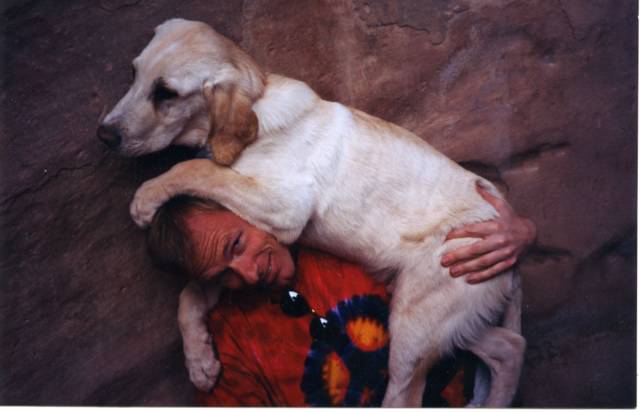
As my friend Kevin Cromer observed, Jackson was regal and majestic. He seemed to know how good looking he was even though his real beauty came from within. Though he could be a little snooty with other dogs, he loved any person who was open to giving him a chance. With dogs he was usually the alpha. With people, he was putty, doing whatever it took to get attention and to give his love. Though once he was in command of his human handlers his independence became evident and he had a determined stubborn streak.
Through the force of his personality Jackson created a world that served his every need. Jackson and I were apart for a few extened periods--though I visited him during those separations. During the times we were apart, he was living it up on my Mom’s farm in Ohio. Even when we lived together he rallied a small army of people to serve him for the parts of the day or week when I wasn’t available. If he wasn’t outside on some mini-adventure, he loved to stay close to me. When I worked at my computer he often crammed himself under my desk so he could be as close as possible.
Jackson meant the world to me, providing an anchor to my peripatetic life. Living up to his role as the ideal dog, his devotion was complete. No matter where I went, or how often I packed everything up and moved, he happily came along (though the moves did unnerve him, about as much as they unnerved me).
He was smart, gorgeous, and loving. Mostly, he was an easy dog to be around and to take care of. Quiet over ninety-five percent of the time, he had a distinctive, loud bark that he employed anytime he thought he heard something. Though they say a dog’s hearing is much more sensitive than ours, I am convinced he had the tendency to bark at ghosts on occasion. But maybe he really did hear those ghosts . . . .
The end of his life came far too suddenly, as well as too soon. I am still reeling by the events of the final two days of his life. He died on October 25, 2004 in Phoenix after we discovered cancer was running rampant inside of him. He had just turned eight.
Jackson owns a piece of my heart. He also earned a place in the hearts of many others.
Thank you Jackson--we miss you.
Woof, woof!
Jim Breitinger
Phoenix, Arizona
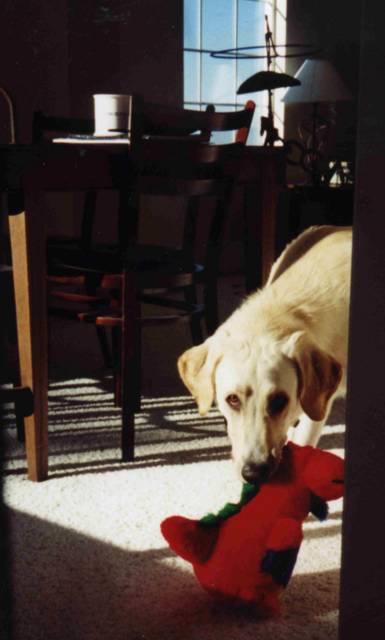
PS--See photos below, and below those a timeline of Jackson's life.
I think Briony is right, though I am eternally grateful for the role David played too.
On Thanksgiving Day in 1996 a little puppy picked David and me as his new parents. He was just seven and a half weeks old. On that day we brought him home to our house in Lindon, Utah. We had about sixteen people over to celebrate Thanksgiving, which needless to say overwhelmed this little puppy who curled up in a corner and waited for the crowd to disburse.
The pup was born in Provo on October 16, 1996. His mother was a registered Great Pyrenees, though she was small for that breed so she may have been a mix. His father was a dog from a one night stand. Steve Hegerhorst, who had the mother and saw the father run off after doing the deed, said he was a Golden Retriever.
We named the pup T. Jackson Powell. I insisted that this was a puppy who was more than important enough to have a proper name. David came up with Jackson, after Jackson Hole, Wyoming. The T. was for Thanksgiving in honor of both the day Jackson entered our lives and the feeling we felt in having him join our family. Powell was after John Wesley Powell, the nineteenth century explorer and policy maker. Powell led the first expedition down the Colorado River in 1869. He created the Bureau of Ethnology which studied and documented the cultures of American Indians. He also was the head of the U.S. Geological Survey from 1881 to 1894.
Our little Jackson was a gorgeous puppy who only got better looking as he grew up.
We took him to puppy pre-school at our local Petsmart. He won the best in class award, beating out Donny Osmond’s Black Lab. We were so focused on our little guy that it took us three classes before we finally realized that yes that was the guy from television in our obedience class with us. We considered the Osmond puppy unruly.
Like John Wesley Powell, Jackson led an adventurous life--flying on airplanes and traveling tens of thousands of miles in cars, mostly our 1997 Subaru. He went on ferry’s, slept on sail boats, went motor-boating, and camping. He was a willing and eager explorer, as long as someone was close by--usually me. We spent many many hours hiking, mountain biking, and cross-country skiing. He spent over three years of his life living on three different farms (including a ranch) where he roamed with total freedom.
Jackson called four states home for nine months or more. These were Utah, Ohio, Virginia, and Arizona. He also visited at least twenty other states and the District of Columbia, as well as Canada. The stupidest move of his life was when he nearly leaped into the rushing water at the top of Niagara Falls, a move that could have also taken me with him either accidentally as I was holding his leash, or in desperation to save him. We had just parked the Subaru and walked toward the noise of the falls, somewhat oblivious to our exact location. We approached a stone wall, and for a reason I will never understand Jackson leapt on top of this little wall which couldn’t have been more than six inches wide. On the other side was a twenty to thirty foot drop to the Niagara River, just before it plunges 170 feet. While I was unnerved by him nearly going into the cataract below, neither he nor I realized how close we were to the top of the falls until a few minutes after the incident.
As my friend Kevin Cromer observed, Jackson was regal and majestic. He seemed to know how good looking he was even though his real beauty came from within. Though he could be a little snooty with other dogs, he loved any person who was open to giving him a chance. With dogs he was usually the alpha. With people, he was putty, doing whatever it took to get attention and to give his love. Though once he was in command of his human handlers his independence became evident and he had a determined stubborn streak.
Through the force of his personality Jackson created a world that served his every need. Jackson and I were apart for a few extened periods--though I visited him during those separations. During the times we were apart, he was living it up on my Mom’s farm in Ohio. Even when we lived together he rallied a small army of people to serve him for the parts of the day or week when I wasn’t available. If he wasn’t outside on some mini-adventure, he loved to stay close to me. When I worked at my computer he often crammed himself under my desk so he could be as close as possible.
Jackson meant the world to me, providing an anchor to my peripatetic life. Living up to his role as the ideal dog, his devotion was complete. No matter where I went, or how often I packed everything up and moved, he happily came along (though the moves did unnerve him, about as much as they unnerved me).
He was smart, gorgeous, and loving. Mostly, he was an easy dog to be around and to take care of. Quiet over ninety-five percent of the time, he had a distinctive, loud bark that he employed anytime he thought he heard something. Though they say a dog’s hearing is much more sensitive than ours, I am convinced he had the tendency to bark at ghosts on occasion. But maybe he really did hear those ghosts . . . .
The end of his life came far too suddenly, as well as too soon. I am still reeling by the events of the final two days of his life. He died on October 25, 2004 in Phoenix after we discovered cancer was running rampant inside of him. He had just turned eight.
Jackson owns a piece of my heart. He also earned a place in the hearts of many others.
Thank you Jackson--we miss you.
Woof, woof!
Jim Breitinger
Phoenix, Arizona
PS--See photos below, and below those a timeline of Jackson's life.


Timeline and Settings of Jackson’s Life
October 16, 1996 Born
Young pup with his litter in Provo, Utah till Thanksgiving Day 1996
November 1996 to May 1998
Raised by Jim and David in Lindon, Utah
Many trips to southern Utah
May 1998 to August 1999
Fly (alone) to Ohio
Living it up at August Hill Farm, Lexington, Ohio
August 1999 to early May of 2001
Fly back to Utah--August '99
Urban living in Salt Lake City at the base of Utah’s Capitol Hill
First goes to Urban Dog (now Dog Mode) in August ‘99
City Creek Canyon and the Bonneville Trail
Intra-Utah travel
Three trips to Montana
First trip to California June/July 2000
May 2001
Drives east from Utah to Ohio via I-80
Layover in Ohio at August Hill Farm for five weeks
On to Virginia via PA Turnpike
June/July 2001
Reunited with Jim in Virginia, on the road till late July:
From Virginia to Dutchess County, New York and Windrock Farm
On to Canada along the old Erie Canal route across NY
Stop at Niagara Falls
Overnight in downtown Toronto
On to Mackinac Island, Michigan going north around Lake Huron
South to Ohio
West to Utah via St. Louis and Denver
July to October 2001
Living with Jim, at friend’s between Big and Little Cottonwood Canyons, Utah
Great hiking!
Side trip to San Francisco
Late October 2001 to December 15 2001
Jim and Jackson move to Barb’s in Summit Park, near Park City, Utah
Incredible hiking and running and rolling in the snow
December 15, 2001 to April 2002
Shipped off to Ohio again by plane--to August Hill Farm. Third extended visit in Ohio and second longest time away from Jim who was busy with the Olympics. Able to run free.
April to October 2002
Back with Jim, living at Barb's in Summit Park
In time for more cross country skiing before the snow melts
Lots of hiking in the mountains, woof!
Late October 2002
Drive east from Park City, Utah
Stops in Minneapolis, Mackinac Island, Ohio--Fox Hollow
November 2002 to August 1, 2003
Living in Berryville, Virginia
Life on the farm is kind of laid back
Early August 2003
Drive back to Utah
Stops in Ohio, Illinois (Doug, Nancy, Chopin and Co.), Colorado
Continue south from Utah to new home in Arizona
Mid-August 2003, to July 13, 2004
Roaming free at Beaver Creek Ranch
Trip to Utah (April ’04)
Tour the West: California, Oregon, Idaho, Utah (June ’04)
July 13 to October 25, 2004
Phoenix
Way too young to go!
Young pup with his litter in Provo, Utah till Thanksgiving Day 1996
November 1996 to May 1998
Raised by Jim and David in Lindon, Utah
Many trips to southern Utah
May 1998 to August 1999
Fly (alone) to Ohio
Living it up at August Hill Farm, Lexington, Ohio
August 1999 to early May of 2001
Fly back to Utah--August '99
Urban living in Salt Lake City at the base of Utah’s Capitol Hill
First goes to Urban Dog (now Dog Mode) in August ‘99
City Creek Canyon and the Bonneville Trail
Intra-Utah travel
Three trips to Montana
First trip to California June/July 2000
May 2001
Drives east from Utah to Ohio via I-80
Layover in Ohio at August Hill Farm for five weeks
On to Virginia via PA Turnpike
June/July 2001
Reunited with Jim in Virginia, on the road till late July:
From Virginia to Dutchess County, New York and Windrock Farm
On to Canada along the old Erie Canal route across NY
Stop at Niagara Falls
Overnight in downtown Toronto
On to Mackinac Island, Michigan going north around Lake Huron
South to Ohio
West to Utah via St. Louis and Denver
July to October 2001
Living with Jim, at friend’s between Big and Little Cottonwood Canyons, Utah
Great hiking!
Side trip to San Francisco
Late October 2001 to December 15 2001
Jim and Jackson move to Barb’s in Summit Park, near Park City, Utah
Incredible hiking and running and rolling in the snow
December 15, 2001 to April 2002
Shipped off to Ohio again by plane--to August Hill Farm. Third extended visit in Ohio and second longest time away from Jim who was busy with the Olympics. Able to run free.
April to October 2002
Back with Jim, living at Barb's in Summit Park
In time for more cross country skiing before the snow melts
Lots of hiking in the mountains, woof!
Late October 2002
Drive east from Park City, Utah
Stops in Minneapolis, Mackinac Island, Ohio--Fox Hollow
November 2002 to August 1, 2003
Living in Berryville, Virginia
Life on the farm is kind of laid back
Early August 2003
Drive back to Utah
Stops in Ohio, Illinois (Doug, Nancy, Chopin and Co.), Colorado
Continue south from Utah to new home in Arizona
Mid-August 2003, to July 13, 2004
Roaming free at Beaver Creek Ranch
Trip to Utah (April ’04)
Tour the West: California, Oregon, Idaho, Utah (June ’04)
July 13 to October 25, 2004
Phoenix
Way too young to go!
Saturday, November 06, 2004
The End
Jackson’s life came to an abrupt end.
As late as Tuesday October 19 I didn’t notice any symptoms that he was sick. On Saturday, concerned because he wasn’t eating and wasn’t himself, I took him to the vet. Still, I wasn’t overly worried.
It turns out there was reason to be. They told me he had cancer. By the following Monday he was gone after an exploratory surgery confirmed the cancer and that it had already spread extensively.
The cards, emails, flowers, phone calls, etc. that I got from so many people after Jackson died made a huge difference for me. Thank you to everyone from me and in spirit—Jackson.
One of my favorite sentiments was from a relative in Flagstaff. She wrote “Someone once said that dogs' lives are shorter than humans because it takes a lifetime for people to learn how to love, dogs know from the beginning.”
My mother, who knew Jackson well, mirrored that sentiment. She said he was what we strive to be, a completely spiritually evolved being.
Everyone who saw Jackson and I together saw that we had a special bond. Some people didn’t necessarily understand it, I don’t know that I even understand it, but it was and is real.
Jim
In late 2002 Jackson and I moved to Summit Park near Park City, Utah. We rented part of a house from Barbara Felt, who also lived there with her daughter Megan. The following is from Barb:
The second week you were here, in the living room, you said "watch this. Jackson, go give Megan a kiss.” (Jackson got up and went right to Meg and gave her a big lick.)
“Now, Jackson, go shake Barbara’s hand." (He came straight to me with that huge paw outstretched).
We knew then that he was unusually humanlike.
Later there was that time when I took him running down the backside of Jeremy ranch on a leash that lasted about half the run, when he could not withhold any longer and decided if I was going to be on the other end of that leash, I was going in the river with him. I let go. He beamed.
Remember the day I though I’d lost him at the cabin on top? Well, he fooled me again. When you came to help rescue, there he was, waiting at the car.
Barb
Some more information I got from Steve, the guy we got Jackson from:
Jackson's mother was the daughter of two working sheep dogs who lived on a ranch somewhere in Utah. Her name is Oso, which means bear in Spanish. About a year ago she ran off during a storm and they were unable to find her, which was brutal for Steve and his family. Oso was terrified of loud noises and between the thunder and some fireworks that day she got scared and ran away. Despite an extensive search, they were unable to find her.
All of this explains a few things about Jackson. He loved to try to round up cars and trucks when he was roaming free on a ranch or farm. It was a strong instinct that was all but impossible to control. He also hated loud noises.
As far as Steve knew there are two siblings of Jackson's left in Provo, in the neighborhood where he was born. Their names are Cody and Sammy. We know of two other litter mates that were with their original [human] families for a year or less before moving on to other homes. We've lost track of them. Jackson's sister Andy died of cancer when she was still a pup.
On Jackson's second plane trip:
In a very generous offer, my friend Jim offered to fly me to Utah to visit him. Of course I accepted, willing to perform the deed required; I had to fly Jackson from Ohio to Salt Lake.
What a trip it was! Jackson and I drove to Cleveland. He had a very big crate. I gave him his sleepy drugs, kissed him on the nose, and off he went on the conveyor belt. I almost cried I was so worried about him travelling in the belly of the airplane. But off he went and I waited. And waited. And began watching the weather. Which got worse. And worse. And worse. Until finally my flight was cancelled. After much bantering with the clerks, they finally understood that I had to get Jackson out of baggage and back home until the next night, when it would be safe to fly. At last his crate appeared, but Jackson was at the height of sleepiness. He weighed a lot. It took every bit of strength I had, along with a helpful baggage handler, to get him out of the crate and into my pickup truck. He slept all the way home.
The next night the weather cleared and we were scheduled again. Fewer sleepy drugs (I had used most of them up the night before), crating, and waiting. I boarded the plane, making sure to get a seat where I could see the baggage being loaded. They wheeled Jackson out and I started to cry. Poor Jackson, directly down beneath me in with the baggage! Those droopy big brown eyes. I was a wreck and I started crying. I worried and fretted all the way to Salt Lake. Would he dehydrate? Would he have enough air? Would he feel sick and throw up? Was he being jostled or bumped?
None of the bad stuff happened and we made it to meet Jim. What a wonderful reunion for all three! The trip was awesome, with Jim showing me everything wonderful to be found in Salt Lake. A salty float in the lake after a wild thunderstorm had to be the highlight. Or maybe it was the hike among the aspens up on the mountain, with Jackson leading the way. Or walking through the downtown dog park with Jackson off the leash. The whole trip was absolutely amazing! Thank you Jim, and thank you Jackson.
Marijan Grogoza
[I never drugged Jackson again on his future plane trips. -JB]
If you have any good Jackson stories, please send me an email at utahredrock at yahoo.com
As late as Tuesday October 19 I didn’t notice any symptoms that he was sick. On Saturday, concerned because he wasn’t eating and wasn’t himself, I took him to the vet. Still, I wasn’t overly worried.
It turns out there was reason to be. They told me he had cancer. By the following Monday he was gone after an exploratory surgery confirmed the cancer and that it had already spread extensively.
The cards, emails, flowers, phone calls, etc. that I got from so many people after Jackson died made a huge difference for me. Thank you to everyone from me and in spirit—Jackson.
One of my favorite sentiments was from a relative in Flagstaff. She wrote “Someone once said that dogs' lives are shorter than humans because it takes a lifetime for people to learn how to love, dogs know from the beginning.”
My mother, who knew Jackson well, mirrored that sentiment. She said he was what we strive to be, a completely spiritually evolved being.
Everyone who saw Jackson and I together saw that we had a special bond. Some people didn’t necessarily understand it, I don’t know that I even understand it, but it was and is real.
Jim
In late 2002 Jackson and I moved to Summit Park near Park City, Utah. We rented part of a house from Barbara Felt, who also lived there with her daughter Megan. The following is from Barb:
The second week you were here, in the living room, you said "watch this. Jackson, go give Megan a kiss.” (Jackson got up and went right to Meg and gave her a big lick.)
“Now, Jackson, go shake Barbara’s hand." (He came straight to me with that huge paw outstretched).
We knew then that he was unusually humanlike.
Later there was that time when I took him running down the backside of Jeremy ranch on a leash that lasted about half the run, when he could not withhold any longer and decided if I was going to be on the other end of that leash, I was going in the river with him. I let go. He beamed.
Remember the day I though I’d lost him at the cabin on top? Well, he fooled me again. When you came to help rescue, there he was, waiting at the car.
Barb
Some more information I got from Steve, the guy we got Jackson from:
Jackson's mother was the daughter of two working sheep dogs who lived on a ranch somewhere in Utah. Her name is Oso, which means bear in Spanish. About a year ago she ran off during a storm and they were unable to find her, which was brutal for Steve and his family. Oso was terrified of loud noises and between the thunder and some fireworks that day she got scared and ran away. Despite an extensive search, they were unable to find her.
All of this explains a few things about Jackson. He loved to try to round up cars and trucks when he was roaming free on a ranch or farm. It was a strong instinct that was all but impossible to control. He also hated loud noises.
As far as Steve knew there are two siblings of Jackson's left in Provo, in the neighborhood where he was born. Their names are Cody and Sammy. We know of two other litter mates that were with their original [human] families for a year or less before moving on to other homes. We've lost track of them. Jackson's sister Andy died of cancer when she was still a pup.
On Jackson's second plane trip:
In a very generous offer, my friend Jim offered to fly me to Utah to visit him. Of course I accepted, willing to perform the deed required; I had to fly Jackson from Ohio to Salt Lake.
What a trip it was! Jackson and I drove to Cleveland. He had a very big crate. I gave him his sleepy drugs, kissed him on the nose, and off he went on the conveyor belt. I almost cried I was so worried about him travelling in the belly of the airplane. But off he went and I waited. And waited. And began watching the weather. Which got worse. And worse. And worse. Until finally my flight was cancelled. After much bantering with the clerks, they finally understood that I had to get Jackson out of baggage and back home until the next night, when it would be safe to fly. At last his crate appeared, but Jackson was at the height of sleepiness. He weighed a lot. It took every bit of strength I had, along with a helpful baggage handler, to get him out of the crate and into my pickup truck. He slept all the way home.
The next night the weather cleared and we were scheduled again. Fewer sleepy drugs (I had used most of them up the night before), crating, and waiting. I boarded the plane, making sure to get a seat where I could see the baggage being loaded. They wheeled Jackson out and I started to cry. Poor Jackson, directly down beneath me in with the baggage! Those droopy big brown eyes. I was a wreck and I started crying. I worried and fretted all the way to Salt Lake. Would he dehydrate? Would he have enough air? Would he feel sick and throw up? Was he being jostled or bumped?
None of the bad stuff happened and we made it to meet Jim. What a wonderful reunion for all three! The trip was awesome, with Jim showing me everything wonderful to be found in Salt Lake. A salty float in the lake after a wild thunderstorm had to be the highlight. Or maybe it was the hike among the aspens up on the mountain, with Jackson leading the way. Or walking through the downtown dog park with Jackson off the leash. The whole trip was absolutely amazing! Thank you Jim, and thank you Jackson.
Marijan Grogoza
[I never drugged Jackson again on his future plane trips. -JB]
If you have any good Jackson stories, please send me an email at utahredrock at yahoo.com
Monday, August 23, 2004
The Orchids of Arizona
Orchids growing in Arizona? And in the wild? This seemed like a fantastic concept to me, so I spent some time checking into it further.
Last week I drove north from Phoenix and the Valley of the Heat to meet up with my friend Mike Currie, a graduate student in botany at Northern Arizona University (NAU) in Flagstaff. I’d been bugging him to go on an orchid collecting trip for a few months, and we finally found a time that worked for both of us.
From Flagstaff we continued northeast to the Navajo Nation and specifically to Navajo National Monument, an enclave administered by the United States Park Service within the Navajo reservation. The monument was a revelation for me. I’ve made dozens of trips to the canyon country of the Colorado Plateau and consider it to be one of my favorite places on earth. It is so special in part because it is so full of surprises. When you explore the canyon country you quickly discover there is much more to it than you initially imagined.
Navajo National Monument exists primarily to preserve ancient cliff dwellings of the people know as the Anasazi by the Navajo. The Navajo themselves are relative late comers (1500s) to the area, pushing out the Hopi Indians, who are believed to have descended from the cliff dwellers who built the seven hundred year old ruins that remain today.
While the cliff dwellings were magnificent, what really got my attention were Betatakin Canyon and its flora in the heart of the monument. Here there are fir trees and aspens amidst a desert ecosystem dominated by the more familiar junipers and pinions. The firs are especially magnificent. The overall population of fir trees is small, but some of them are giants in diameter. They are similar to what you would see in redwood forests--trees whose girths are simply astounding. The quaking aspens cast their magical spell over the canyon which at 7,000 feet remains cool enough for these trees to survive. After weeks in the heat of Phoenix, I’d arrived in paradise.
Firs and aspens amidst juniper and pinyon trees in a redrock canyon of the Colorado Plateau! This region never ceases to amaze.
And what about those orchids? Betatakin Canyon is home to two of Arizona’s thirty-some species of orchids. My trip leader, botanist Mike Currie, set about examining, documenting, and collecting cuttings from the endangered alcove bog orchid that he is studying for his graduate work at NAU. Once I calmed down after the surprise of seeing aspens and firs, I let Mike show me his orchids.
While he was thrilled after discovering the largest population of bog orchids he had ever observed, I couldn’t help but state that these orchids were a little disappointing. They are not nearly as showy as some of their more famous cousins. Their flowers looked more like a miniature version of the spiky flower of a yucca, then what I’d come to think of as the flashy orchid. My previous exposure to orchids came on a trip in the Ecuadorian Amazon where large showy orchids grew along the roads and rivers in abundance. Mike gave me a tutorial on the wide variety of orchids and was undeterred by my reaction. The other orchid of Betatakin Canyon, the stream orchid, is much showier. Another Arizona orchid is the fairy slipper orchid found in the San Francisco Peaks which is showy enough that it is sold commercially. But we came to see the humble bog orchid, which showy are not, was still an orchid.
In 1986 Larry Higgens and Stan Welsh, two Utah botanists, classified the bog orchids, which are only found in the American Southwest, into two species: alpine and alcove. Mike believes they are actually one species and proving this is the thrust of his study. An important part of his work involves genetic research. He will be extracting DNA from the leaf cuttings and comparing the genetic code to other cuttings he’s gathered from different populations, as well as the alpine bog orchid, in his effort to see whether or not there is a difference between the two bog orchids. His work is also part of a broader genetics study of the evolutionary relationships between species. Mike is the final student to earn a bachelors degree in botany from NAU due to budget cutbacks.
So yes, Arizona does have orchids which are not just limited to the tropics--they even grow in the harsh deserts and mountains of the American Southwest including the ever surprising Colorado Plateau region. It was refreshing to see a native Arizonan who’d discovered a passion for orchids while studying at NAU. In the great American tradition, he’s scraping by while he follows his passion and at the same time advances our knowledge about the world we live in.
Last week I drove north from Phoenix and the Valley of the Heat to meet up with my friend Mike Currie, a graduate student in botany at Northern Arizona University (NAU) in Flagstaff. I’d been bugging him to go on an orchid collecting trip for a few months, and we finally found a time that worked for both of us.
From Flagstaff we continued northeast to the Navajo Nation and specifically to Navajo National Monument, an enclave administered by the United States Park Service within the Navajo reservation. The monument was a revelation for me. I’ve made dozens of trips to the canyon country of the Colorado Plateau and consider it to be one of my favorite places on earth. It is so special in part because it is so full of surprises. When you explore the canyon country you quickly discover there is much more to it than you initially imagined.
Navajo National Monument exists primarily to preserve ancient cliff dwellings of the people know as the Anasazi by the Navajo. The Navajo themselves are relative late comers (1500s) to the area, pushing out the Hopi Indians, who are believed to have descended from the cliff dwellers who built the seven hundred year old ruins that remain today.
While the cliff dwellings were magnificent, what really got my attention were Betatakin Canyon and its flora in the heart of the monument. Here there are fir trees and aspens amidst a desert ecosystem dominated by the more familiar junipers and pinions. The firs are especially magnificent. The overall population of fir trees is small, but some of them are giants in diameter. They are similar to what you would see in redwood forests--trees whose girths are simply astounding. The quaking aspens cast their magical spell over the canyon which at 7,000 feet remains cool enough for these trees to survive. After weeks in the heat of Phoenix, I’d arrived in paradise.
Firs and aspens amidst juniper and pinyon trees in a redrock canyon of the Colorado Plateau! This region never ceases to amaze.
And what about those orchids? Betatakin Canyon is home to two of Arizona’s thirty-some species of orchids. My trip leader, botanist Mike Currie, set about examining, documenting, and collecting cuttings from the endangered alcove bog orchid that he is studying for his graduate work at NAU. Once I calmed down after the surprise of seeing aspens and firs, I let Mike show me his orchids.
While he was thrilled after discovering the largest population of bog orchids he had ever observed, I couldn’t help but state that these orchids were a little disappointing. They are not nearly as showy as some of their more famous cousins. Their flowers looked more like a miniature version of the spiky flower of a yucca, then what I’d come to think of as the flashy orchid. My previous exposure to orchids came on a trip in the Ecuadorian Amazon where large showy orchids grew along the roads and rivers in abundance. Mike gave me a tutorial on the wide variety of orchids and was undeterred by my reaction. The other orchid of Betatakin Canyon, the stream orchid, is much showier. Another Arizona orchid is the fairy slipper orchid found in the San Francisco Peaks which is showy enough that it is sold commercially. But we came to see the humble bog orchid, which showy are not, was still an orchid.
In 1986 Larry Higgens and Stan Welsh, two Utah botanists, classified the bog orchids, which are only found in the American Southwest, into two species: alpine and alcove. Mike believes they are actually one species and proving this is the thrust of his study. An important part of his work involves genetic research. He will be extracting DNA from the leaf cuttings and comparing the genetic code to other cuttings he’s gathered from different populations, as well as the alpine bog orchid, in his effort to see whether or not there is a difference between the two bog orchids. His work is also part of a broader genetics study of the evolutionary relationships between species. Mike is the final student to earn a bachelors degree in botany from NAU due to budget cutbacks.
So yes, Arizona does have orchids which are not just limited to the tropics--they even grow in the harsh deserts and mountains of the American Southwest including the ever surprising Colorado Plateau region. It was refreshing to see a native Arizonan who’d discovered a passion for orchids while studying at NAU. In the great American tradition, he’s scraping by while he follows his passion and at the same time advances our knowledge about the world we live in.
Thursday, July 29, 2004
Wednesday, July 28, 2004
Adventures with Pigs
“You pigs are getting too close! Go away!!” I said two nights ago at about 11 PM.
My friend Nate and I were beginning our three day adventure on Santa Cruz Island, part of the Channel Islands, and Channel Islands National Park. We departed the mainland at Ventura, California an hour north of Los Angeles.
The excitement began on the ferry ride over. We rode in a “high-speed” catamaran which went about 25 MPH over the surface of the Pacific (not sure how many knots that is). Our first sighting of interest was a group of sea lions on a buoy at the harbor exit. En route to the island, the viewing got much better.
We began to see dolphins and our captain slowed the ferry to give us a better view. Before we knew it we were surrounded by dozens of these playful mammals of the sea. When we picked up speed again they raced off our bow, where some of us were standing. Just below my feet, the cousins of Flipper were cruising at high speed, coming up for air every 20-30 seconds and giving us quite a show.
After an hour at sea, we arrived at Santa Cruz Island. There to meet us was Ranger Dan, United States Park Service.
“Welcome to Santa Cruz Island,” he said in his welcoming speech. Just before this he called my friend Nate “buddy” in the tone of voice a ranger might use when speaking to a twelve year old. Ranger Dan was younger than Nate, by what looked like about ten years. Nate was offended by the greeting.
“One thing you’ll notice as you’re going to sleep tonight is a lot of noise, and if you have a light you will see the source. We have thousands of wild pigs here on the island. They are a legacy of the ranching days, and they will come right in to camp. They won’t hurt you, but make sure you keep all of your food in the storage bins we provide. If the pigs don’t get it, the mice will. The ground around here literally moves at night.”
After informing us of the dangers of hantavirus, a frequently fatal respiratory disease spread by mouse feces (it is also rarely contracted), Ranger Dan had our attention regarding the pigs and the mice.
This end of the island is known as Scorpion Ranch (apparently they have scorpions too). The Scorpion Ranch area is equipped to handle the most visitors of any site on Santa Cruz Island, up to 250 campers. We had something less than a third of that number, with fewer than twenty people in the Upper Campground where we set up our base. The entire island is 62,000 acres--about three times the size of Manhattan.
After Ranger Dan’s speech, which was quite elaborate as well as corny in a way that only a Park Service ranger can be, we dropped our gear at our campsite and prepared for our first sea kayaking adventure. We got a screaming deal on a two man sea kayak just before boarding the ferry.
Nate and I headed out to sea, he with his digital camera and no waterproof bag. This would be the shorter of our two sea kayaking tours. It was a great introduction. Though there are some rocky beaches, the ocean meets most of the island where the land jutsstraight up, rising up to 1,000 feet along most of the coastline. The effect is spectacular. We in our sea kayak at the base of this mountain rising out of the sea felt small and vulnerable against the power of the ocean and the mass of the island next to us.
We explored one or two sea caves, floating into dark spaces on our kayak. As we paddled along the coastline, we came to a point and continued on. Around the point the waves were much bigger and it was windier. We turned back. A few minutes later we ran in to a man and his son and said hello. He asked if we had been around the nearby point, telling us there were wonderful sea caves just on the other side.
Bravely, or stupidly, we followed them. We got wet the first time, but this time we were in the big waves longer. We would paddle over the crest of a wave, plunge down the other side, and at least every fourth wave would break over the kayak. Since Nate was in front, he got soaked. His camera was a casualty of this adventure.
We hiked that afternoon, met a couple named Ben and Julie, ate some food and by 7:30, with about ninety minutes of daylight left, we both fell asleep.
We planned to be backpacking, so we brought the minimal amount of gear. Both of us were sleeping under the stars (and you could see the stars! The lights of LA were too far away to affect the night view). I was on my Mega-rest air mattress by Thermarest. Nate just slept on the ground--in a sleeping bag. Shortly after dark the invasion of the wild pigs began.
These guys came within ten feet of us. They had a feast eating the grass, and who knows what else, just around our camp. We were both exhausted, but the pigs woke us and got our attention. There was some grunting just beyond Nate. I was convinced that he was just messing with me, but eventually realized he wasn’t. The sound was very close. After a few minutes of pig observing, we both fell back to sleep. The rest of the night I would occasionally be startled awake by the sound of some 300 pound creature that was way too close. Yet after yelling at the pigs to “go away,” I always fell asleep again in a short amount of time. They never did follow my commands, even though they are supposed to be smart.
The next morning we rose with the sun, ate, and headed back out to sea. This time we were out for about three hours in the kayak. The ocean was calmer. We saw some sea lions, or seals--not sure what the proper nomenclature is. The tide was much lower than when we went out the day before. The lower water level revealed thousands of starfish, clinging to the rocky side of the island’s waterline where its rocky sides meet the Pacific. The most memorable thing was the many sea caves.
We’d paddle back in to the darkness of one cave after another. While the ocean was calmer than the day before, it still had its normal waves with the occasionally larger than normal swell. When a big wave came in to a cave, it would push us up toward the rocky ceiling, and scare the crap out of us as we were treated like a cork in a container of water--with the cave being the container. At one point we were at least 350 feet back in a long narrow cave. It was spooky, but very cool.
After kayaking and lunch we headed out for a hike. The island is very mountainous, with its highest point rising over 2,000 feet above the ocean, so the hike was a good workout. At the beginning of our hike we happened across Ben and Julie, who we’d met the night before (and who were not a couple, or so they said). Along with them was a group of three guys that they met in camp--Warren, Chad, and Tim. We were to become the Santa Cruz Seven. For the next 24 plus hours we all hung out together.
The hike was fantastic. We were up in the fog covered mountains. The fog burned off before our descent, providing stunning views of the ocean around us. That section of the island was about two miles in width. We bushwhacked around looking for pigs. I never saw one during the day (where do they go??) but Nate, Julie, and Ben had a close encounter with a 300 hundred pounder. The landscape reminded me of the paramo ecosystem in the Andes. The Channel Islands are very dry most of the time, but not as dry as Arizona, and cooler as well, so the flora had a very different look about it.
Tim, Chad, and Warren hosted a dinner party in camp that lived up to its billing. They fed us salmon, salad, and more. Nate and I just had backpacking food with us, so this was a major treat. We stayed up talking for hours, until everyone faded, which probably wasn’t that late. Once the sun goes down, and without electricity, you tend to go to sleep earlier.
The last day on the island was more relaxed. We split up in to smaller groups and did various short hikes. Nate and I arrived back at his apartment in Pasadena around 7 PM, exhausted again. Nikki made a great dinner and we crashed. She took care of Jackson while we went on our island adventure and Jackson was perfectly content under her care.
The next morning Jackson and I left, heading north through California’s Central Valley--the most productive agricultural region in the world and one of the wonders of 20th century technology and ingenuity conquering nature.
Regards,
Jim
Written in Pasadena and Portland
Sent from Salt Lake City
And entered as my first blog from my new home in Phoenix a couple weeks later
My friend Nate and I were beginning our three day adventure on Santa Cruz Island, part of the Channel Islands, and Channel Islands National Park. We departed the mainland at Ventura, California an hour north of Los Angeles.
The excitement began on the ferry ride over. We rode in a “high-speed” catamaran which went about 25 MPH over the surface of the Pacific (not sure how many knots that is). Our first sighting of interest was a group of sea lions on a buoy at the harbor exit. En route to the island, the viewing got much better.
We began to see dolphins and our captain slowed the ferry to give us a better view. Before we knew it we were surrounded by dozens of these playful mammals of the sea. When we picked up speed again they raced off our bow, where some of us were standing. Just below my feet, the cousins of Flipper were cruising at high speed, coming up for air every 20-30 seconds and giving us quite a show.
After an hour at sea, we arrived at Santa Cruz Island. There to meet us was Ranger Dan, United States Park Service.
“Welcome to Santa Cruz Island,” he said in his welcoming speech. Just before this he called my friend Nate “buddy” in the tone of voice a ranger might use when speaking to a twelve year old. Ranger Dan was younger than Nate, by what looked like about ten years. Nate was offended by the greeting.
“One thing you’ll notice as you’re going to sleep tonight is a lot of noise, and if you have a light you will see the source. We have thousands of wild pigs here on the island. They are a legacy of the ranching days, and they will come right in to camp. They won’t hurt you, but make sure you keep all of your food in the storage bins we provide. If the pigs don’t get it, the mice will. The ground around here literally moves at night.”
After informing us of the dangers of hantavirus, a frequently fatal respiratory disease spread by mouse feces (it is also rarely contracted), Ranger Dan had our attention regarding the pigs and the mice.
This end of the island is known as Scorpion Ranch (apparently they have scorpions too). The Scorpion Ranch area is equipped to handle the most visitors of any site on Santa Cruz Island, up to 250 campers. We had something less than a third of that number, with fewer than twenty people in the Upper Campground where we set up our base. The entire island is 62,000 acres--about three times the size of Manhattan.
After Ranger Dan’s speech, which was quite elaborate as well as corny in a way that only a Park Service ranger can be, we dropped our gear at our campsite and prepared for our first sea kayaking adventure. We got a screaming deal on a two man sea kayak just before boarding the ferry.
Nate and I headed out to sea, he with his digital camera and no waterproof bag. This would be the shorter of our two sea kayaking tours. It was a great introduction. Though there are some rocky beaches, the ocean meets most of the island where the land jutsstraight up, rising up to 1,000 feet along most of the coastline. The effect is spectacular. We in our sea kayak at the base of this mountain rising out of the sea felt small and vulnerable against the power of the ocean and the mass of the island next to us.
We explored one or two sea caves, floating into dark spaces on our kayak. As we paddled along the coastline, we came to a point and continued on. Around the point the waves were much bigger and it was windier. We turned back. A few minutes later we ran in to a man and his son and said hello. He asked if we had been around the nearby point, telling us there were wonderful sea caves just on the other side.
Bravely, or stupidly, we followed them. We got wet the first time, but this time we were in the big waves longer. We would paddle over the crest of a wave, plunge down the other side, and at least every fourth wave would break over the kayak. Since Nate was in front, he got soaked. His camera was a casualty of this adventure.
We hiked that afternoon, met a couple named Ben and Julie, ate some food and by 7:30, with about ninety minutes of daylight left, we both fell asleep.
We planned to be backpacking, so we brought the minimal amount of gear. Both of us were sleeping under the stars (and you could see the stars! The lights of LA were too far away to affect the night view). I was on my Mega-rest air mattress by Thermarest. Nate just slept on the ground--in a sleeping bag. Shortly after dark the invasion of the wild pigs began.
These guys came within ten feet of us. They had a feast eating the grass, and who knows what else, just around our camp. We were both exhausted, but the pigs woke us and got our attention. There was some grunting just beyond Nate. I was convinced that he was just messing with me, but eventually realized he wasn’t. The sound was very close. After a few minutes of pig observing, we both fell back to sleep. The rest of the night I would occasionally be startled awake by the sound of some 300 pound creature that was way too close. Yet after yelling at the pigs to “go away,” I always fell asleep again in a short amount of time. They never did follow my commands, even though they are supposed to be smart.
The next morning we rose with the sun, ate, and headed back out to sea. This time we were out for about three hours in the kayak. The ocean was calmer. We saw some sea lions, or seals--not sure what the proper nomenclature is. The tide was much lower than when we went out the day before. The lower water level revealed thousands of starfish, clinging to the rocky side of the island’s waterline where its rocky sides meet the Pacific. The most memorable thing was the many sea caves.
We’d paddle back in to the darkness of one cave after another. While the ocean was calmer than the day before, it still had its normal waves with the occasionally larger than normal swell. When a big wave came in to a cave, it would push us up toward the rocky ceiling, and scare the crap out of us as we were treated like a cork in a container of water--with the cave being the container. At one point we were at least 350 feet back in a long narrow cave. It was spooky, but very cool.
After kayaking and lunch we headed out for a hike. The island is very mountainous, with its highest point rising over 2,000 feet above the ocean, so the hike was a good workout. At the beginning of our hike we happened across Ben and Julie, who we’d met the night before (and who were not a couple, or so they said). Along with them was a group of three guys that they met in camp--Warren, Chad, and Tim. We were to become the Santa Cruz Seven. For the next 24 plus hours we all hung out together.
The hike was fantastic. We were up in the fog covered mountains. The fog burned off before our descent, providing stunning views of the ocean around us. That section of the island was about two miles in width. We bushwhacked around looking for pigs. I never saw one during the day (where do they go??) but Nate, Julie, and Ben had a close encounter with a 300 hundred pounder. The landscape reminded me of the paramo ecosystem in the Andes. The Channel Islands are very dry most of the time, but not as dry as Arizona, and cooler as well, so the flora had a very different look about it.
Tim, Chad, and Warren hosted a dinner party in camp that lived up to its billing. They fed us salmon, salad, and more. Nate and I just had backpacking food with us, so this was a major treat. We stayed up talking for hours, until everyone faded, which probably wasn’t that late. Once the sun goes down, and without electricity, you tend to go to sleep earlier.
The last day on the island was more relaxed. We split up in to smaller groups and did various short hikes. Nate and I arrived back at his apartment in Pasadena around 7 PM, exhausted again. Nikki made a great dinner and we crashed. She took care of Jackson while we went on our island adventure and Jackson was perfectly content under her care.
The next morning Jackson and I left, heading north through California’s Central Valley--the most productive agricultural region in the world and one of the wonders of 20th century technology and ingenuity conquering nature.
Regards,
Jim
Written in Pasadena and Portland
Sent from Salt Lake City
And entered as my first blog from my new home in Phoenix a couple weeks later
Friday, July 02, 2004
Photo of Santa Cruz Seven
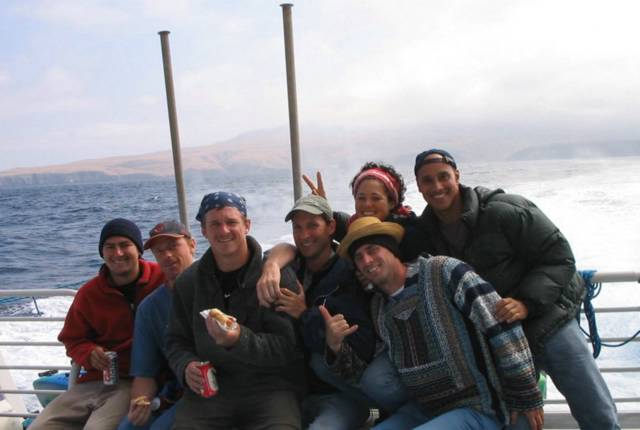
The Santa Cruz Seven, en route back to Ventura, California (double click on photo for a larger/clearer view)

Thursday, June 17, 2004
Perfectly Exquisite
Ahhhh, to be a denizen of the twenty-first century.
With my new sound system installed in my Subaru, I headed up the freeway this evening from Phoenix--coming back to my soon to be former haven on Beaver Creek.
The freeway! That mid-twentieth century creation that seems so pedestrian, yet is so revolutionary. It cuts its well graded, well designed way through the deserts and mountains of Arizona, making eighty mile an hour travel a breeze while climbing thousands of feet through treacherous terrain. The route from Phoenix toBeaver Creek Ranch is now an easy one. As recently as thirty to forty years ago, the same journey would have taken many times as long--dominated by less direct highways and more miles of dirt roads (only the final mile remains unpaved, thank God!).
The sound system! Not only did I upgrade from the analog technology of cassette tapes to the digital technology of compact discs, I also became an adopterof that twenty-first century innovation: satellite radio. With 110 stations available no matter where I travel, including up the canyons of Beaver Creek (as well as far more remote areas), the programming that is available is astounding. The program mixes “fed” to me by my satellite provider--Sirius--were outstanding. I chose Sirius over their competitor XM Radio, because they provide NPR as one of their feeds. I guess this means I really am a liberal! (Oh brother.)
And the wilds! About halfway between the metropolis ofPhoenix, and my remote ranch on Beaver Creek, right on the interstate freeway, a large mountain lion ran in front of me. Even with our fancy roads and sound systems, wild America lingers on. The cat was huge and graceful.
As I prepare for an all too brief, slightly less than three week tour of the West Coast, I am reconnecting to the grid via satellite and cell phone. No more remote Arizona ranch life for me. I move to Phoenix on July 12, unemployed and looking for work.
Regards,
Jim and Jackson
At Beaver Creek Ranch under intense starshine
10 PM
June 17, 2004
With my new sound system installed in my Subaru, I headed up the freeway this evening from Phoenix--coming back to my soon to be former haven on Beaver Creek.
The freeway! That mid-twentieth century creation that seems so pedestrian, yet is so revolutionary. It cuts its well graded, well designed way through the deserts and mountains of Arizona, making eighty mile an hour travel a breeze while climbing thousands of feet through treacherous terrain. The route from Phoenix toBeaver Creek Ranch is now an easy one. As recently as thirty to forty years ago, the same journey would have taken many times as long--dominated by less direct highways and more miles of dirt roads (only the final mile remains unpaved, thank God!).
The sound system! Not only did I upgrade from the analog technology of cassette tapes to the digital technology of compact discs, I also became an adopterof that twenty-first century innovation: satellite radio. With 110 stations available no matter where I travel, including up the canyons of Beaver Creek (as well as far more remote areas), the programming that is available is astounding. The program mixes “fed” to me by my satellite provider--Sirius--were outstanding. I chose Sirius over their competitor XM Radio, because they provide NPR as one of their feeds. I guess this means I really am a liberal! (Oh brother.)
And the wilds! About halfway between the metropolis ofPhoenix, and my remote ranch on Beaver Creek, right on the interstate freeway, a large mountain lion ran in front of me. Even with our fancy roads and sound systems, wild America lingers on. The cat was huge and graceful.
As I prepare for an all too brief, slightly less than three week tour of the West Coast, I am reconnecting to the grid via satellite and cell phone. No more remote Arizona ranch life for me. I move to Phoenix on July 12, unemployed and looking for work.
Regards,
Jim and Jackson
At Beaver Creek Ranch under intense starshine
10 PM
June 17, 2004
Sunday, March 28, 2004
Last March in Georgia
Have you ever felt the power of a horse beneath you as you raced like a madman across the countryside? With hooves pounding, and your mount giving his all: reaching, straining, gasping for air?
Have you ever raced down impossibly steep terrain, steeper than you would attempt on your own feet, then back up, wondering how your horse can stay upright and sure you will both come crashing down?
Have you ever dodged hardwood trees, steering your horse along at a gallop, trusting in something higher than you that you won’t loose a leg, or a knee, part of your face, or an eye?
Have you ever jumped obstacles on horseback, taking off from impossible positions, giving your life over to the athleticism of your horse?
Welcome to foxhunting. This is an account from last March, of a day I spent in Georgia, riding with the some of the best horses and horsemen in America.
>>>>>>>
Gina Salatino is an experienced foxhunter. She's hunted throughout North America, in England and in Ireland. My sister Elise is just as experienced and just as well traveled. Last week Elise and Gina took five of us to hunt with Belle Meade Hunt in Thompson, Georgia--a hunt they billed as the best in North America. Thompson is near Augusta, home of the Master's Golf Tournament.
Foxhunting is a sport that is little understood by people who've never ridden in a hunt. While I've hunted off and on now for over two decades, this has been my most active season. I am basically a rank novice to the sport.
Many people have some sense of foxhunting. Most everyone has seen a hunt painting or print, though they may not realize it. Hunt prints are populated with horses and riders galloping across idyllic rural landscapes as streaking hounds lead the way. The riders are dressed in britches with high black leather boots. They wear black or red coats, and top off their outfits with a black velvet hunt cap or silk top hat. The film Mary Poppins even incorporates a foxhunt into the story.
A hunt scene strongly suggests the eighteenth century and aristocratic England. This strong association and kinship with the past is one of the most compelling aspects of the sport. It has a look and feel that is very distinct to another era even as it thrives today.
By reputation, this is a sport for blue bloods. The associations with upper class Britain and uppity people taint the whole idea of foxhunting for many. It would be highly disingenuous to deny this aspect of the sport, but people assign meaning to foxhunting just at they do to anything. Whether someone associates glory and beauty with the sport, or resentment of privilege that is born and not earned, or something else, is a choice for each person to make.
Hunting is more controversial then ever today in Great Britain where it is on the verge of being banned by the government. Class associations and resentments fuel the controversy. In America, land of the Second Amendment, hunting of any kind isn't as controversial as it is in Britain. Yet as civilization removes us further and further from our hunter-gatherer pasts, hunting of all types faces many threats.
Genealogy aside, Elise and Gina are not blue bloods. They aren't people who were granted access to this sport simply by being born into a family that set them up for life with land and horses. Both of these women hunt because they are passionate about hunting. They have created lives for themselves that make it possible to participate in foxhunting and they work as hard as anyone I know to pursue their passion. Both of them make a living, in part at least, by breeding and training horses to hunt to the hounds.
Elise overcame a debilitating accident where she was nearly crushed to death and lost her hip—-she now has a fake one. The doctors told her she'd never ride again, but once she got her new hip they couldn't keep her off a horse. Five years after her accident, her pain is just now becoming more bearable and her riding is finally getting back to where it was before her accident. Through her ordeal, she only missed two seasons of hunting.
Fox were considered vermin in Britain and the British still generally hunt to kill. In North America, with wilder, more expansive terrain, foxhunting has always been a sport focused on the chase rather than the kill. Kills are rare here. To the non-hunter it may sound ludicrous, but foxes enjoy the sport as much as the hounds and riders. This is evident in their cunning and showy playfulness as they taunt the hounds on a chase.
Our hunt at Belle Meade last week began on a very warm early spring day at 5 PM. I was riding Kenny, a five-year-old Thoroughbred/Quarter Horse cross. This is Kenny's first full hunt season and I've been his principle rider since November. I was nervous as the hunt began after hearing Gina and Elise go on and on about how this hunt was serious business and we were guaranteed good sport. Good sport means fast and furious riding and lots of jumping. These are the reason we love to hunt, but the wild nature of the sport can also be intimidating. Even Elise and Gina have a healthy respect for the dangers of fox hunting, though it is the dangerous aspect of it that draws them back time and time again.
The first hour of the hunt was fairly slow as the hounds milled around looking for the scent. Belle Meade's hunt country, like so much of North America, has been overtaken by coyotes. When coyotes move in, fox are pushed out. They still have some fox in this part of Georgia, but usually the hounds find coyotes. Coyote runs tend to cover more ground. They are faster, straighter, and longer than a typical fox run.
At about 6 PM the hounds were finally on to something. We were riding in what is called "the field," behind the field master. The field is all of the horses and riders that are out for the chase. The huntsman and his staff were off in the near distance, working the hounds in pursuit of the scent of a fox or coyote. When the hounds get on to a scent they go into a full cry and take off in pursuit of their prey. For someone like my sister, the sound of hounds on a run is pure music. Even for me, someone born with a lack of hunting genes of any kind (whether fox, coyote, pheasant, duck, or deer), the sound of hounds in full cry is something.
As the hounds began singing and running, we waited a few minutes more to see which direction they were headed. Then we too were off.
For the next hour we galloped madly through Georgia's red clay country. The Belle Meade hunt has permission to ride over tens of thousands of acres of open land, all privately owned. We crossed fields, cut through woods, and crossed treacherous creeks that cut deep through the clay. Belle Meade is infamous for its many difficult creek crossings. They've installed bridges throughout their hunt country, but many crossings still require doing it the old fashioned way--dropping down in to the deep cuts in the land, and climbing back up the other side.
My horse, Kenny, was afraid of water at the beginning of this hunt season. He nearly killed himself and me the first time we went out together with Middleburg Hunt in Virginia. At Belle Meade he showed his increasing maturity. While our crossing weren't always pretty, he was a different horse compared to last November.
Even so, we still managed to have one especially ugly moment at the day’s worst crossing. It included an especially steep and dramatic drop of about fifty feet to a creek, where the horses essentially had to sit down as they dropped down the steep walls of the ravine. Kenny went down faster than I wanted him too, jumped the water and despite my efforts to slow him charged straight up the other side like a cat. He ignored the trail, making his own. I stayed on and somehow he stayed upright climbing the nearly vertical embankment and crashing through fallen trees and limbs on the way up. Any other horse pulling such a stupid stunt would have ended up doing somersaults down to the bottom of the ravine. Kenny's athleticism saved us both.
The daylight began fading by 6:45 and we were still galloping madly. About this time I had my second faux pas. We were charging along with another creek to our left, this time going parallel to it. The ground was flat where we were but dropped off ten feet just to the left of our trail. As a result I overcompensated to the right and crashed in to a tree while at full speed, banging my knee so hard that even my sister cringed as she heard my bone hitting the wood. I wasn't seriously injured, but did knock the wind out of myself and gasped for air as we continued our gallop through the woods. This mishap refocused my attention on avoiding the trees, as well as the precipitous drops.
Our run ended, incongruously, next to an Interstate highway. This modern thoroughfare had its own high pitched scream which drowned out that of the hounds. By this time it was time to call it a day as our daylight faded to darkness. We headed in as the huntsman and his staff gathered up the hounds, some of whom were miles away, off on another run.
The ride back to our meeting place lasted another hour. I was eager to see if the moon was out and had a hard time finding it. The night sky seemed bright and I finally tilted my helmeted head back far enough to see the half moon straight over head. The moonshine lit our way casting shadows of horses and riders and trees as we headed in. What is it about the moon that has such a powerful pull on us? Of course it is strong enough to move oceans, so it is no surprise that we feel its powerful presence.
The field was very large that day, especially considering it was midweek. There were about twenty-five of us in the field and about twenty-five more who rode with the hilltop group. The hilltoppers ride at a slower pace avoiding jumps and the difficult creek crossings.
Because it was so warm (80 degrees when we began in the late afternoon), jackets were waived. People were still dressed up and we were a sight not too different from that of any hunt print.
This year Belle Meade constructed a new clubhouse where we were served dinner after the hunt. The members of the hunt were warm and friendly—living up to the notion of southern charm.
A beautiful painting sat on the floor next to the chair where I collapsed with my food. The picture was of a handsome and confident man, clearly a hunt master, on his horse with hounds around him. I asked someone about it and was told a brief history of a man named Master James Wilson, Junior, one of Belle Meade's founding members. His son, Epp, served as a master along side him beginning in the mid 1980s. Epp is still master today and served as our huntsman. His father, known to thousands as Master James, died last April just shy of his eightieth birthday after a long and full life. His biggest legacy, outside of his family, is the hunt that he helped found and build into what today is widely regarded as one of North America's best.
As we prepared to head out that night, Elise and I spoke to Epp. She knew him from previous hunting experiences. I was meeting him for the first time. Our aunt, Lynne Ashbrook, is also an avid foxhunter. This month Lynne stepped down after leading Rocky Fork Headly Hunt in Columbus, Ohio for seventeen years. Epp told us how he remembered hunting with her and he commented about what a talented woman she is with her hounds. As much as anyone, I owe my riding career to my aunt and her contribution to me when I was young. It was great to hear her spoken of in such a way from someone who was clearly an accomplished huntsman himself.
With foxhunting in its fourth century, I feel lucky to be participating in this old tradition. George Washington was an avid foxhunter. Thomas Jefferson hunted as well.
It was an unforgettable moonlit night in Georgia, riding to the hounds.
Jim Breitinger
March 19, 2003 (Finished March '04)
Have you ever raced down impossibly steep terrain, steeper than you would attempt on your own feet, then back up, wondering how your horse can stay upright and sure you will both come crashing down?
Have you ever dodged hardwood trees, steering your horse along at a gallop, trusting in something higher than you that you won’t loose a leg, or a knee, part of your face, or an eye?
Have you ever jumped obstacles on horseback, taking off from impossible positions, giving your life over to the athleticism of your horse?
Welcome to foxhunting. This is an account from last March, of a day I spent in Georgia, riding with the some of the best horses and horsemen in America.
>>>>>>>
Gina Salatino is an experienced foxhunter. She's hunted throughout North America, in England and in Ireland. My sister Elise is just as experienced and just as well traveled. Last week Elise and Gina took five of us to hunt with Belle Meade Hunt in Thompson, Georgia--a hunt they billed as the best in North America. Thompson is near Augusta, home of the Master's Golf Tournament.
Foxhunting is a sport that is little understood by people who've never ridden in a hunt. While I've hunted off and on now for over two decades, this has been my most active season. I am basically a rank novice to the sport.
Many people have some sense of foxhunting. Most everyone has seen a hunt painting or print, though they may not realize it. Hunt prints are populated with horses and riders galloping across idyllic rural landscapes as streaking hounds lead the way. The riders are dressed in britches with high black leather boots. They wear black or red coats, and top off their outfits with a black velvet hunt cap or silk top hat. The film Mary Poppins even incorporates a foxhunt into the story.
A hunt scene strongly suggests the eighteenth century and aristocratic England. This strong association and kinship with the past is one of the most compelling aspects of the sport. It has a look and feel that is very distinct to another era even as it thrives today.
By reputation, this is a sport for blue bloods. The associations with upper class Britain and uppity people taint the whole idea of foxhunting for many. It would be highly disingenuous to deny this aspect of the sport, but people assign meaning to foxhunting just at they do to anything. Whether someone associates glory and beauty with the sport, or resentment of privilege that is born and not earned, or something else, is a choice for each person to make.
Hunting is more controversial then ever today in Great Britain where it is on the verge of being banned by the government. Class associations and resentments fuel the controversy. In America, land of the Second Amendment, hunting of any kind isn't as controversial as it is in Britain. Yet as civilization removes us further and further from our hunter-gatherer pasts, hunting of all types faces many threats.
Genealogy aside, Elise and Gina are not blue bloods. They aren't people who were granted access to this sport simply by being born into a family that set them up for life with land and horses. Both of these women hunt because they are passionate about hunting. They have created lives for themselves that make it possible to participate in foxhunting and they work as hard as anyone I know to pursue their passion. Both of them make a living, in part at least, by breeding and training horses to hunt to the hounds.
Elise overcame a debilitating accident where she was nearly crushed to death and lost her hip—-she now has a fake one. The doctors told her she'd never ride again, but once she got her new hip they couldn't keep her off a horse. Five years after her accident, her pain is just now becoming more bearable and her riding is finally getting back to where it was before her accident. Through her ordeal, she only missed two seasons of hunting.
Fox were considered vermin in Britain and the British still generally hunt to kill. In North America, with wilder, more expansive terrain, foxhunting has always been a sport focused on the chase rather than the kill. Kills are rare here. To the non-hunter it may sound ludicrous, but foxes enjoy the sport as much as the hounds and riders. This is evident in their cunning and showy playfulness as they taunt the hounds on a chase.
Our hunt at Belle Meade last week began on a very warm early spring day at 5 PM. I was riding Kenny, a five-year-old Thoroughbred/Quarter Horse cross. This is Kenny's first full hunt season and I've been his principle rider since November. I was nervous as the hunt began after hearing Gina and Elise go on and on about how this hunt was serious business and we were guaranteed good sport. Good sport means fast and furious riding and lots of jumping. These are the reason we love to hunt, but the wild nature of the sport can also be intimidating. Even Elise and Gina have a healthy respect for the dangers of fox hunting, though it is the dangerous aspect of it that draws them back time and time again.
The first hour of the hunt was fairly slow as the hounds milled around looking for the scent. Belle Meade's hunt country, like so much of North America, has been overtaken by coyotes. When coyotes move in, fox are pushed out. They still have some fox in this part of Georgia, but usually the hounds find coyotes. Coyote runs tend to cover more ground. They are faster, straighter, and longer than a typical fox run.
At about 6 PM the hounds were finally on to something. We were riding in what is called "the field," behind the field master. The field is all of the horses and riders that are out for the chase. The huntsman and his staff were off in the near distance, working the hounds in pursuit of the scent of a fox or coyote. When the hounds get on to a scent they go into a full cry and take off in pursuit of their prey. For someone like my sister, the sound of hounds on a run is pure music. Even for me, someone born with a lack of hunting genes of any kind (whether fox, coyote, pheasant, duck, or deer), the sound of hounds in full cry is something.
As the hounds began singing and running, we waited a few minutes more to see which direction they were headed. Then we too were off.
For the next hour we galloped madly through Georgia's red clay country. The Belle Meade hunt has permission to ride over tens of thousands of acres of open land, all privately owned. We crossed fields, cut through woods, and crossed treacherous creeks that cut deep through the clay. Belle Meade is infamous for its many difficult creek crossings. They've installed bridges throughout their hunt country, but many crossings still require doing it the old fashioned way--dropping down in to the deep cuts in the land, and climbing back up the other side.
My horse, Kenny, was afraid of water at the beginning of this hunt season. He nearly killed himself and me the first time we went out together with Middleburg Hunt in Virginia. At Belle Meade he showed his increasing maturity. While our crossing weren't always pretty, he was a different horse compared to last November.
Even so, we still managed to have one especially ugly moment at the day’s worst crossing. It included an especially steep and dramatic drop of about fifty feet to a creek, where the horses essentially had to sit down as they dropped down the steep walls of the ravine. Kenny went down faster than I wanted him too, jumped the water and despite my efforts to slow him charged straight up the other side like a cat. He ignored the trail, making his own. I stayed on and somehow he stayed upright climbing the nearly vertical embankment and crashing through fallen trees and limbs on the way up. Any other horse pulling such a stupid stunt would have ended up doing somersaults down to the bottom of the ravine. Kenny's athleticism saved us both.
The daylight began fading by 6:45 and we were still galloping madly. About this time I had my second faux pas. We were charging along with another creek to our left, this time going parallel to it. The ground was flat where we were but dropped off ten feet just to the left of our trail. As a result I overcompensated to the right and crashed in to a tree while at full speed, banging my knee so hard that even my sister cringed as she heard my bone hitting the wood. I wasn't seriously injured, but did knock the wind out of myself and gasped for air as we continued our gallop through the woods. This mishap refocused my attention on avoiding the trees, as well as the precipitous drops.
Our run ended, incongruously, next to an Interstate highway. This modern thoroughfare had its own high pitched scream which drowned out that of the hounds. By this time it was time to call it a day as our daylight faded to darkness. We headed in as the huntsman and his staff gathered up the hounds, some of whom were miles away, off on another run.
The ride back to our meeting place lasted another hour. I was eager to see if the moon was out and had a hard time finding it. The night sky seemed bright and I finally tilted my helmeted head back far enough to see the half moon straight over head. The moonshine lit our way casting shadows of horses and riders and trees as we headed in. What is it about the moon that has such a powerful pull on us? Of course it is strong enough to move oceans, so it is no surprise that we feel its powerful presence.
The field was very large that day, especially considering it was midweek. There were about twenty-five of us in the field and about twenty-five more who rode with the hilltop group. The hilltoppers ride at a slower pace avoiding jumps and the difficult creek crossings.
Because it was so warm (80 degrees when we began in the late afternoon), jackets were waived. People were still dressed up and we were a sight not too different from that of any hunt print.
This year Belle Meade constructed a new clubhouse where we were served dinner after the hunt. The members of the hunt were warm and friendly—living up to the notion of southern charm.
A beautiful painting sat on the floor next to the chair where I collapsed with my food. The picture was of a handsome and confident man, clearly a hunt master, on his horse with hounds around him. I asked someone about it and was told a brief history of a man named Master James Wilson, Junior, one of Belle Meade's founding members. His son, Epp, served as a master along side him beginning in the mid 1980s. Epp is still master today and served as our huntsman. His father, known to thousands as Master James, died last April just shy of his eightieth birthday after a long and full life. His biggest legacy, outside of his family, is the hunt that he helped found and build into what today is widely regarded as one of North America's best.
As we prepared to head out that night, Elise and I spoke to Epp. She knew him from previous hunting experiences. I was meeting him for the first time. Our aunt, Lynne Ashbrook, is also an avid foxhunter. This month Lynne stepped down after leading Rocky Fork Headly Hunt in Columbus, Ohio for seventeen years. Epp told us how he remembered hunting with her and he commented about what a talented woman she is with her hounds. As much as anyone, I owe my riding career to my aunt and her contribution to me when I was young. It was great to hear her spoken of in such a way from someone who was clearly an accomplished huntsman himself.
With foxhunting in its fourth century, I feel lucky to be participating in this old tradition. George Washington was an avid foxhunter. Thomas Jefferson hunted as well.
It was an unforgettable moonlit night in Georgia, riding to the hounds.
Jim Breitinger
March 19, 2003 (Finished March '04)
Thursday, January 08, 2004
A Hike for Mary
Today at Southwestern Academy--Beaver Creek Ranch:
Western writer Mary Austin lived a hundred years ago. Austin was a pioneering woman of the American West. She arrived from Wisconsin at the age of twenty with her family after the death of her father. The California desert captivated her and she went onto become one of the most successful female writers of her era--and a revered writer of the West.
Her most famous book is called “The Land of Little Rain.” In that book and in her other writings, Austin celebrates the desert southwest for its haunting beauty. She championed all that is wild, including the indigenous Indians. At that time the Indians of the southwest were still close to their culture’s traditions, though western civilization was beginning to overtake them.
During our long block period today (three hours since it spans lunch), our environmental history class, consisting of four young women (from four different countries), headed to Sedona to hike in honor of Mary Austin.
After a lunch in town, we did a short hike on one of Sedona’s many stunning trails.
On this warm and sunny January day, the sky was a vivid blue, the air clear and clean. We hiked up the trail, surrounded on all sides by soaring redrock cliffs. We did a short reading from Mary Austin, and took in the beauty of the desert around us. Even a sometimes jaded, beach-loving, Californiateenager begrudgingly admitted:“Yeah, it’s pretty beautiful.”
Today four young women of the twenty-first century experienced the words and passions of a woman of the nineteenth century (1868-1934). Here’s to Mary Austin and the western deserts she loved.
Western writer Mary Austin lived a hundred years ago. Austin was a pioneering woman of the American West. She arrived from Wisconsin at the age of twenty with her family after the death of her father. The California desert captivated her and she went onto become one of the most successful female writers of her era--and a revered writer of the West.
Her most famous book is called “The Land of Little Rain.” In that book and in her other writings, Austin celebrates the desert southwest for its haunting beauty. She championed all that is wild, including the indigenous Indians. At that time the Indians of the southwest were still close to their culture’s traditions, though western civilization was beginning to overtake them.
During our long block period today (three hours since it spans lunch), our environmental history class, consisting of four young women (from four different countries), headed to Sedona to hike in honor of Mary Austin.
After a lunch in town, we did a short hike on one of Sedona’s many stunning trails.
On this warm and sunny January day, the sky was a vivid blue, the air clear and clean. We hiked up the trail, surrounded on all sides by soaring redrock cliffs. We did a short reading from Mary Austin, and took in the beauty of the desert around us. Even a sometimes jaded, beach-loving, Californiateenager begrudgingly admitted:“Yeah, it’s pretty beautiful.”
Today four young women of the twenty-first century experienced the words and passions of a woman of the nineteenth century (1868-1934). Here’s to Mary Austin and the western deserts she loved.
Saturday, November 01, 2003
The View From Here
Here, is Beaver Creek Ranch, tucked in the Arizona wilderness twenty miles from Sedona. The ranch is the campus of Southwestern Academy where I am teaching, living, and--increasingly--administering.
It rained this afternoon. Our first rain in a month. It doesn’t rain much here.
As promised by our headmaster, the canyon walls are singing with color. The rain darkened the redrock sandstone to a deep hue. A few minutes ago, the skies cleared enough to let in the setting sun. The results are beyond words.
My office includes a view over the riparian zone of Beaver Creek. The creek flows year round here, in the Arizona desert. It is fed by springs, the water clear and clean. Beyond the riparian zone, thick with large deciduous trees, the canyon wall rises five hundred feet.
My view is divided in two: the bottom half is dominated by the center of our ranch campus, the top half is a redrock wall, covered in prickly pear cactus and other desert flora.
It is a large view, but it doesn’t include much sky. Being in the arid West, however, we have ample light. The light is the thing I missed the most during my nine months in Virginia last year.
It was exactly 363 days ago today that I arrived in Berryville, and now here I am over half a continent away, teaching history, getting to know my students and new colleagues, and enjoying the light show on our canyon wall.
My email address has been utahredrock now for about five years. I am not ready to change it at this point, since it is the only piece of contact information of mine that hasn’t changed in five years. Still, I am relishing the Arizona Redrock, a close relative to its Utah neighbors.
Regards,
Jim and Jackson--the greatest dog in the world
PS—As I finish writing this little piece it is now dark and raining yet again. I am starting to enjoy the rain once more--and to welcome it--something I was unable to do this spring when I was wallowing in mud and constantly wet.
It rained this afternoon. Our first rain in a month. It doesn’t rain much here.
As promised by our headmaster, the canyon walls are singing with color. The rain darkened the redrock sandstone to a deep hue. A few minutes ago, the skies cleared enough to let in the setting sun. The results are beyond words.
My office includes a view over the riparian zone of Beaver Creek. The creek flows year round here, in the Arizona desert. It is fed by springs, the water clear and clean. Beyond the riparian zone, thick with large deciduous trees, the canyon wall rises five hundred feet.
My view is divided in two: the bottom half is dominated by the center of our ranch campus, the top half is a redrock wall, covered in prickly pear cactus and other desert flora.
It is a large view, but it doesn’t include much sky. Being in the arid West, however, we have ample light. The light is the thing I missed the most during my nine months in Virginia last year.
It was exactly 363 days ago today that I arrived in Berryville, and now here I am over half a continent away, teaching history, getting to know my students and new colleagues, and enjoying the light show on our canyon wall.
My email address has been utahredrock now for about five years. I am not ready to change it at this point, since it is the only piece of contact information of mine that hasn’t changed in five years. Still, I am relishing the Arizona Redrock, a close relative to its Utah neighbors.
Regards,
Jim and Jackson--the greatest dog in the world
PS—As I finish writing this little piece it is now dark and raining yet again. I am starting to enjoy the rain once more--and to welcome it--something I was unable to do this spring when I was wallowing in mud and constantly wet.
Tuesday, July 29, 2003
Thank You Virginia
The marathon continues.
A few months ago a friend of mine revealed to me that every time she hears about yet one more dramatic change in my life she laughs. “There he goes again,” I imagined her thinking, leaving me somewhat offended. I felt compelled to inform her that I am more apt to cry. Leaving Utah last October was heart wrenching for me. I love that place. Felt rooted there. Yet I felt the same thing about Virginia when I left for Utah in 1994.
I am terribly excited about this move to Arizona, and just as likely to cry as I leave yet another place.
I intended to come to Virginia for a season, and that’s what I’ve done; though it has literally been three earth seasons--nine months exactly. Nine months of devotion to Whiskey Creek Farms, my sister Elise’s horse farm, her business, and passion.
In their majesty and power, horses have defined my time here.. In their constant demand for care, attention, feeding, training, doctoring, medicating, and mucking up after. Yes, the mucking up after them will leave a big imprint on my memories--it is a lot of work.
The biggest impression though is reserved for all of the riding, the jumping, the tacking up, the hacking out, the flat work, the dressage lessons, the foxhunting, and even the horse shows (which I avoid like the plague, but still played a role in from behind the scenes).
The personalities of the horses, yes, that is the strongest impression of this time here, and they have been my best friends and most constant companions. As far as time and attention the horses got far more of my time than even Jackson--the greatest dog in the world, though barn life has suited him well.
Each horse has a personality as distinct as any person. They are not people of course, they are very much their own species, but oh how they have personality, or should I call it equininality? (Pronounced ee kwine an al it ee.)
Kenny was the defining horse of my time here. Quirky, unpredictable, athletic as hell, difficult, talented, and that overused equine word: spirited. He is also just a major goofball, and a gorgeous one too. Despite his antics, I feel at home on his back. Even with heroic bucking, leaping, and shying, he never managed to dismount me involuntarily. Shortly after my arrival here when we were out with the Middleburg Hunt he was having a particularly bad day, leaping over the multiple water crossings we encountered. At one point he leaped and crash-landed on his chest and stomach on the opposite bank of a creek crossing. Suddenly finding my feet on the ground, though I was still on his back, I got off so the fool could get back up. While I got off of him (my pride feels compelled to emphasize) that I did not “fall” off of him.
But I am not sure Kenny deserves too much credit, there have been so many horses I will never forget.
Duncan, who failed the basic safety test by his insistence on rearing, one of the most dangerous things a horse can do. Rearing is when they go up in the air standing only on their two hind legs. (Ask my sister who was crushed and nearly killed by a horse who reared up, fell backwards, and mashed her into the ground. She has the handicapped license plates and artificial hip to remind her of that experience). I loved Duncan but he had to go, to God knows where, the poor soul.
Winchester, who we got in trade for Duncan turned in to one of our stars. I never warmed to him on the ground; he was too much his own guy, suspicious of affection, or just suspicious of people. I am sure he has his reasons, lord knows what he went through before arriving in our little horse haven. But on his back, and in the hunt field especially . . . what a horse! This guy knows how to take care of himself, and by extension his rider, which was often me. He just went to a new home in Orange County Hunt Country (Virginia). Country that includes the incomparable estate of Paul Mellon--the Paul Mellon of the Mellon bank family, patron of the arts, horseman, grand son of wealth.
Winchester has landed well.
I was able to get acquainted with Quinn before his untimely demise late last November. Quinn was an Irish Sport Horse (that is the name of his breed) that my sister imported as a yearling. He was seven last fall when we had to put him down due to a debilitating disease. But even in the last month of his life, his personality (my made up word being too cumbersome) shined bright. What a cool, cool guy this one was. As a young colt he played soccer, passing the ball to himself as he galloped across large fields. He played with sticks like a dog, though logs or limbs is a more apt word for what he played with. I am sure I met him on earlier visits to Virginia, but I really got to know him this time. The day we put him down was brutal, and my sister will cry just by reading this. I am crying.
The horse angels carried him off to better places.
Waldo is the pride of our farm. He is the son of Quinn and the proud father of seven. His fathering days are now behind him--he was cut just over a year ago. This guy is capital F Fancy. He is four now and for sale as a Show Hunter. He is easy, breezy, kind, and talented. It could be a while before he sells, just because we love him too much.
Silver, Joey, Harry Potter, Frankie, and Walrus (one of Waldo’s sons) are the core of my sister’s personal horses, those that aren’t for sale and that she intends to keep. It must be stated that this is too many horses for one person to own, but a small minority of her personal herd. Of the group Silver gets honorable mention as the number one character of our farm. He is a big, muscular, powerful grey, that to the non-horseman is more of a speckled white in color.
Elliott is another of my favorites. He is another Waldo baby, a yearling now. He is half-brother to Walrus and not as fancy. He’s already been cut (I refer to his testicles here). He is sweeter than sweet. If you go into his field to get another horse he literally shoves his face into yours, gently but firmly demanding acknowledgement and attention. He gets plenty. I will miss him.
Another great joy was our foals. We had six this year, all are doing well. Two are race horse babies, three are Waldo babies, and one is our surprise filly--Madison, a cross between a Thoroughbred and a Cleveland Bay (another breed that I would have to call obscure, not being a real horseman). Madison is a surprise because she is so good looking--but all of our foals are. The other foals of 2003 are Walnut, Charlie Brown, Monterey (my girl), Blue Ridge Prospect, and Sonny. I still have a hard time identifying all of the brood mare mothers, and in tribute to that I won’t list them all here.
The specialty of Whiskey Creek Farms is foxhunting and foxhunters. So let me take a moment to discuss this sport.
Foxhunting, is the sport of blue bloods, also known as rich snobs with more money than good sense. It is that, though I am a personal case in point that on any given day out with a foxhunt there are at least some folks that are penniless.
Foxhunting, the sport that ruthlessly employs vicious hounds against hapless, poor, innocent, and sweet foxes. That is a perspective that completely misses the mark. Without attempting to defend what is admittedly a frivolous sport, I will just point out that American Foxhunting is about the chase, not the kill. I’ve never seen a kill, though they do happen occasionally.
Foxhunting, a sport of eighteenth century fashions and tradition. Whatever your idea is of this sport, I believe it is hard to deny the majesty of it. Galloping across the countryside, dressed like George Washington (an avid foxhunter), or some English lord, with dozens of beautiful horses all around you, following a pack of hounds as they float over the land in full run and on the scent of a fox--there really and truly is nothing like it. I have to say, in the spirit of Ferris Bueller admiring the Porsche of his friend’s father, it is exquisite (though I think Ferris called it “choice”).
Foxhunting is its own thing. It is a tradition that is alive and well.
And yes, many of the people who keep the sport alive, are a bit hard to take.
Present company most definitely included.
And did I say that it terrifies me? I am only somewhat ashamed to admit this. Jumping horses is sort of a big deal to many people. Probably most jumping occurs within a ring, with jumps that are designed to fall if you hit them. Foxhunting is true hunting in that you are out looking for wild animals. (Foxhunts regularly chase after coyote and bobcat too.)
In a foxhunt you race wildly across the countryside usually jumping obstacles that are installed and maintained by the foxhunt, but often encountering natural obstacles, or occasionally fence lines with no jumps in them, leaving you jumping fences to get in and out of fields.
I think that the fear that I experience in the hunt field is both an attractor and a repellent for me to this rarefied sport. During my first five hunts here, I hunted five different horses. For someone with weak nerves like myself, heading in to the hunt field on a different horse each time began to become overwhelming. All of my horses were well qualified (as my sister assured me, and I have to admit was the case). Only Kenny was a true nutcase (so isn’t it perfectly logical that I love him the most?).
I feel compelled to mention the weather in this summary of my time here in Virginia. Despite the admonition of my friend Derrick for my complaining about the weather (an admonition delivered in the dead of winter from his warm office in Atlanta), let me just say this: Mother of God! Take me back to the arid West!
The damp, bone chilling cold.
The snows that are not all that fun (compared to Utah’s “Greatest Snow on Earth” a slogan that is actually on the state’s license plates, and that I wholeheartedly endorse.)
The ice, my God the ice. The trees crumple beneath the weight of this stuff that often coats everything in sight. My poor car was forced to grow new skins of ice in our repeated ice storms, sometimes making it almost impossible just to get in to my car.
The mud. Derrick was not trudging through the mud 8-12 hours a day. I wore out three pairs of boots during my time here. These were good quality work boots.
The rain. From late March to late June, just after what everyone assured me was an unusually brutal winter, it rained and rained and rained. Keep in mind those of us in the horse business that are too poor for indoor arenas and proper engineering of our farms to handle the water, have to be wet and muddy for months on end. No nice warm office in Atlanta here. The rains this spring seemed biblical to me in their relentlessness and in their sheer quantity of water.
The oppressive heat and humidity. I’ve been reminded of what it is like to really sweat. I mean sweat rolling out of your pores like a river. In the West we drink a lot because it is so dry. In the east, on humid days, we drink a lot because water just pours out of us. We had such a prolonged and wet spring that the number of oppressively hot days I’ve experienced to date have been few. A good time to make my exit!
Of course Derrick is right, it is useless to complain about the weather. It is an utter bore and waste of time. But there you have it. The East Coast weather is making me eager for aridity and blue skies yet again. So off I go to what historian Donald Worster writes critically about as the land that through vast engineering efforts is a land where man over-manages and over-manipulates water in a way that is unprecedented in world history. Ahh, the American West!
I do love the horses and I will miss them. There are dozens more that I’ve come to know during my time here who didn’t get a mention in this little essay (Killington and Pokey leap to mind).
So I prepare to hit the road yet again. I have some trepidation. I have high hopes that I am about to land somewhere that I can stay for a while. Staying was never my intention when I came to Virginia last year; this was designed to be a layover. And what a great layover it has been.
So on to Sedona I go, me and Jackson. I will be horseless for a while, but content to know that my equine friends in Virginia are being well cared for in my absence (cheers to Briony, my main human companion and fellow stable worker/horse trainer).
My replacement at the farm arrives from England this Friday, the day I leave. I won’t be meeting her. I am sure she has no idea what she is getting in to, but I am also sure she is one of those women that really really loves horses (I’ve been around too many women like that these nine months!). She will do fine, and our horses are already grateful for her.
From Berryville,
Jim Breitinger
July 29, 2003
A few months ago a friend of mine revealed to me that every time she hears about yet one more dramatic change in my life she laughs. “There he goes again,” I imagined her thinking, leaving me somewhat offended. I felt compelled to inform her that I am more apt to cry. Leaving Utah last October was heart wrenching for me. I love that place. Felt rooted there. Yet I felt the same thing about Virginia when I left for Utah in 1994.
I am terribly excited about this move to Arizona, and just as likely to cry as I leave yet another place.
I intended to come to Virginia for a season, and that’s what I’ve done; though it has literally been three earth seasons--nine months exactly. Nine months of devotion to Whiskey Creek Farms, my sister Elise’s horse farm, her business, and passion.
In their majesty and power, horses have defined my time here.. In their constant demand for care, attention, feeding, training, doctoring, medicating, and mucking up after. Yes, the mucking up after them will leave a big imprint on my memories--it is a lot of work.
The biggest impression though is reserved for all of the riding, the jumping, the tacking up, the hacking out, the flat work, the dressage lessons, the foxhunting, and even the horse shows (which I avoid like the plague, but still played a role in from behind the scenes).
The personalities of the horses, yes, that is the strongest impression of this time here, and they have been my best friends and most constant companions. As far as time and attention the horses got far more of my time than even Jackson--the greatest dog in the world, though barn life has suited him well.
Each horse has a personality as distinct as any person. They are not people of course, they are very much their own species, but oh how they have personality, or should I call it equininality? (Pronounced ee kwine an al it ee.)
Kenny was the defining horse of my time here. Quirky, unpredictable, athletic as hell, difficult, talented, and that overused equine word: spirited. He is also just a major goofball, and a gorgeous one too. Despite his antics, I feel at home on his back. Even with heroic bucking, leaping, and shying, he never managed to dismount me involuntarily. Shortly after my arrival here when we were out with the Middleburg Hunt he was having a particularly bad day, leaping over the multiple water crossings we encountered. At one point he leaped and crash-landed on his chest and stomach on the opposite bank of a creek crossing. Suddenly finding my feet on the ground, though I was still on his back, I got off so the fool could get back up. While I got off of him (my pride feels compelled to emphasize) that I did not “fall” off of him.
But I am not sure Kenny deserves too much credit, there have been so many horses I will never forget.
Duncan, who failed the basic safety test by his insistence on rearing, one of the most dangerous things a horse can do. Rearing is when they go up in the air standing only on their two hind legs. (Ask my sister who was crushed and nearly killed by a horse who reared up, fell backwards, and mashed her into the ground. She has the handicapped license plates and artificial hip to remind her of that experience). I loved Duncan but he had to go, to God knows where, the poor soul.
Winchester, who we got in trade for Duncan turned in to one of our stars. I never warmed to him on the ground; he was too much his own guy, suspicious of affection, or just suspicious of people. I am sure he has his reasons, lord knows what he went through before arriving in our little horse haven. But on his back, and in the hunt field especially . . . what a horse! This guy knows how to take care of himself, and by extension his rider, which was often me. He just went to a new home in Orange County Hunt Country (Virginia). Country that includes the incomparable estate of Paul Mellon--the Paul Mellon of the Mellon bank family, patron of the arts, horseman, grand son of wealth.
Winchester has landed well.
I was able to get acquainted with Quinn before his untimely demise late last November. Quinn was an Irish Sport Horse (that is the name of his breed) that my sister imported as a yearling. He was seven last fall when we had to put him down due to a debilitating disease. But even in the last month of his life, his personality (my made up word being too cumbersome) shined bright. What a cool, cool guy this one was. As a young colt he played soccer, passing the ball to himself as he galloped across large fields. He played with sticks like a dog, though logs or limbs is a more apt word for what he played with. I am sure I met him on earlier visits to Virginia, but I really got to know him this time. The day we put him down was brutal, and my sister will cry just by reading this. I am crying.
The horse angels carried him off to better places.
Waldo is the pride of our farm. He is the son of Quinn and the proud father of seven. His fathering days are now behind him--he was cut just over a year ago. This guy is capital F Fancy. He is four now and for sale as a Show Hunter. He is easy, breezy, kind, and talented. It could be a while before he sells, just because we love him too much.
Silver, Joey, Harry Potter, Frankie, and Walrus (one of Waldo’s sons) are the core of my sister’s personal horses, those that aren’t for sale and that she intends to keep. It must be stated that this is too many horses for one person to own, but a small minority of her personal herd. Of the group Silver gets honorable mention as the number one character of our farm. He is a big, muscular, powerful grey, that to the non-horseman is more of a speckled white in color.
Elliott is another of my favorites. He is another Waldo baby, a yearling now. He is half-brother to Walrus and not as fancy. He’s already been cut (I refer to his testicles here). He is sweeter than sweet. If you go into his field to get another horse he literally shoves his face into yours, gently but firmly demanding acknowledgement and attention. He gets plenty. I will miss him.
Another great joy was our foals. We had six this year, all are doing well. Two are race horse babies, three are Waldo babies, and one is our surprise filly--Madison, a cross between a Thoroughbred and a Cleveland Bay (another breed that I would have to call obscure, not being a real horseman). Madison is a surprise because she is so good looking--but all of our foals are. The other foals of 2003 are Walnut, Charlie Brown, Monterey (my girl), Blue Ridge Prospect, and Sonny. I still have a hard time identifying all of the brood mare mothers, and in tribute to that I won’t list them all here.
The specialty of Whiskey Creek Farms is foxhunting and foxhunters. So let me take a moment to discuss this sport.
Foxhunting, is the sport of blue bloods, also known as rich snobs with more money than good sense. It is that, though I am a personal case in point that on any given day out with a foxhunt there are at least some folks that are penniless.
Foxhunting, the sport that ruthlessly employs vicious hounds against hapless, poor, innocent, and sweet foxes. That is a perspective that completely misses the mark. Without attempting to defend what is admittedly a frivolous sport, I will just point out that American Foxhunting is about the chase, not the kill. I’ve never seen a kill, though they do happen occasionally.
Foxhunting, a sport of eighteenth century fashions and tradition. Whatever your idea is of this sport, I believe it is hard to deny the majesty of it. Galloping across the countryside, dressed like George Washington (an avid foxhunter), or some English lord, with dozens of beautiful horses all around you, following a pack of hounds as they float over the land in full run and on the scent of a fox--there really and truly is nothing like it. I have to say, in the spirit of Ferris Bueller admiring the Porsche of his friend’s father, it is exquisite (though I think Ferris called it “choice”).
Foxhunting is its own thing. It is a tradition that is alive and well.
And yes, many of the people who keep the sport alive, are a bit hard to take.
Present company most definitely included.
And did I say that it terrifies me? I am only somewhat ashamed to admit this. Jumping horses is sort of a big deal to many people. Probably most jumping occurs within a ring, with jumps that are designed to fall if you hit them. Foxhunting is true hunting in that you are out looking for wild animals. (Foxhunts regularly chase after coyote and bobcat too.)
In a foxhunt you race wildly across the countryside usually jumping obstacles that are installed and maintained by the foxhunt, but often encountering natural obstacles, or occasionally fence lines with no jumps in them, leaving you jumping fences to get in and out of fields.
I think that the fear that I experience in the hunt field is both an attractor and a repellent for me to this rarefied sport. During my first five hunts here, I hunted five different horses. For someone with weak nerves like myself, heading in to the hunt field on a different horse each time began to become overwhelming. All of my horses were well qualified (as my sister assured me, and I have to admit was the case). Only Kenny was a true nutcase (so isn’t it perfectly logical that I love him the most?).
I feel compelled to mention the weather in this summary of my time here in Virginia. Despite the admonition of my friend Derrick for my complaining about the weather (an admonition delivered in the dead of winter from his warm office in Atlanta), let me just say this: Mother of God! Take me back to the arid West!
The damp, bone chilling cold.
The snows that are not all that fun (compared to Utah’s “Greatest Snow on Earth” a slogan that is actually on the state’s license plates, and that I wholeheartedly endorse.)
The ice, my God the ice. The trees crumple beneath the weight of this stuff that often coats everything in sight. My poor car was forced to grow new skins of ice in our repeated ice storms, sometimes making it almost impossible just to get in to my car.
The mud. Derrick was not trudging through the mud 8-12 hours a day. I wore out three pairs of boots during my time here. These were good quality work boots.
The rain. From late March to late June, just after what everyone assured me was an unusually brutal winter, it rained and rained and rained. Keep in mind those of us in the horse business that are too poor for indoor arenas and proper engineering of our farms to handle the water, have to be wet and muddy for months on end. No nice warm office in Atlanta here. The rains this spring seemed biblical to me in their relentlessness and in their sheer quantity of water.
The oppressive heat and humidity. I’ve been reminded of what it is like to really sweat. I mean sweat rolling out of your pores like a river. In the West we drink a lot because it is so dry. In the east, on humid days, we drink a lot because water just pours out of us. We had such a prolonged and wet spring that the number of oppressively hot days I’ve experienced to date have been few. A good time to make my exit!
Of course Derrick is right, it is useless to complain about the weather. It is an utter bore and waste of time. But there you have it. The East Coast weather is making me eager for aridity and blue skies yet again. So off I go to what historian Donald Worster writes critically about as the land that through vast engineering efforts is a land where man over-manages and over-manipulates water in a way that is unprecedented in world history. Ahh, the American West!
I do love the horses and I will miss them. There are dozens more that I’ve come to know during my time here who didn’t get a mention in this little essay (Killington and Pokey leap to mind).
So I prepare to hit the road yet again. I have some trepidation. I have high hopes that I am about to land somewhere that I can stay for a while. Staying was never my intention when I came to Virginia last year; this was designed to be a layover. And what a great layover it has been.
So on to Sedona I go, me and Jackson. I will be horseless for a while, but content to know that my equine friends in Virginia are being well cared for in my absence (cheers to Briony, my main human companion and fellow stable worker/horse trainer).
My replacement at the farm arrives from England this Friday, the day I leave. I won’t be meeting her. I am sure she has no idea what she is getting in to, but I am also sure she is one of those women that really really loves horses (I’ve been around too many women like that these nine months!). She will do fine, and our horses are already grateful for her.
From Berryville,
Jim Breitinger
July 29, 2003
Wednesday, May 07, 2003
Monterey
On a cool foggy morning at Whiskey Creek Farms, a new foal greeted her first day.
I was alone at the barn and just beginning the morning feeding routine. I went to get Kodak, our two-year-old stallion, to bring him in to the barn. As a stallion, he naturally tends toward the wild side, but today he was insane. He ignored me as I entered his paddock, standing at the opposite end of the enclosure and staring intently into an adjacent field. He was obsessed and screaming. I followed his gaze into the foggy field and saw the object of his attention. It was a new foal.
Normally when a mare is about to foal she gives some signs. She will wax up on her nipples. Her udder will fill with milk and tighten. Her entire back end may even shift and relax. This mare, Stella, was due May 15 which meant it could be any time now, but she didn’t show any of the telltale signs that she was about to foal so we didn’t have her under the normal “foal watch.”
But foal she did.
I dropped the halter I had in my hand for Kodak, climbed two fences and headed straight for Stella and her baby. Because of the fog it was almost like I’d had a vision of a foal in field where there shouldn’t be a foal yet, and I was just checking the reality of this vision. As I cut through the fog, the foal indeed turned out to be real.
I checked the foal and discovered it was a filly--a female. When a horse is born they stand up almost immediately. This foal was probably about two hours old. She was standing next to her mother--all bones but very tall. She was chestnut with a big white blaze on her face and two white socks on her hind legs. Like all babies, she was a miracle, and beautiful.
I named her Monterey after the Spaniard who ordered an expedition along the West Coast of North America in the early 1600s.
We brought Stella and Monterey into the barn. The filly wasn’t nursing immediately which was a concern, but after a few hours she figured it out.
As I write this she is less than a day old and is doing well.
She is our fifth foal this year. Our sixth, and last, is due in the next ten days.
There aren’t many mornings in life like this one.
I was alone at the barn and just beginning the morning feeding routine. I went to get Kodak, our two-year-old stallion, to bring him in to the barn. As a stallion, he naturally tends toward the wild side, but today he was insane. He ignored me as I entered his paddock, standing at the opposite end of the enclosure and staring intently into an adjacent field. He was obsessed and screaming. I followed his gaze into the foggy field and saw the object of his attention. It was a new foal.
Normally when a mare is about to foal she gives some signs. She will wax up on her nipples. Her udder will fill with milk and tighten. Her entire back end may even shift and relax. This mare, Stella, was due May 15 which meant it could be any time now, but she didn’t show any of the telltale signs that she was about to foal so we didn’t have her under the normal “foal watch.”
But foal she did.
I dropped the halter I had in my hand for Kodak, climbed two fences and headed straight for Stella and her baby. Because of the fog it was almost like I’d had a vision of a foal in field where there shouldn’t be a foal yet, and I was just checking the reality of this vision. As I cut through the fog, the foal indeed turned out to be real.
I checked the foal and discovered it was a filly--a female. When a horse is born they stand up almost immediately. This foal was probably about two hours old. She was standing next to her mother--all bones but very tall. She was chestnut with a big white blaze on her face and two white socks on her hind legs. Like all babies, she was a miracle, and beautiful.
I named her Monterey after the Spaniard who ordered an expedition along the West Coast of North America in the early 1600s.
We brought Stella and Monterey into the barn. The filly wasn’t nursing immediately which was a concern, but after a few hours she figured it out.
As I write this she is less than a day old and is doing well.
She is our fifth foal this year. Our sixth, and last, is due in the next ten days.
There aren’t many mornings in life like this one.
Tuesday, December 24, 2002

Wednesday, July 10, 2002
Salt Lake Cougar
Last night, my friend Jayne and I were walking Jackson in City Creek Canyon in Salt Lake City. On our way back down, at the 2.5 mile mark we saw what we initially thought was a Bobcat, but what I now believe was a cougar, a.k.a. mountain lion. I estimate this cat weighed anywhere from 90 to 150 pounds. He was gorgeous.
When we first saw him he was walking away from us, just 30 feet distant. He was in the streambed; we were on the road about 10 feet higher. We stopped to watch him. He continued for about ten strides and stopped in the shadows, turning around and watching us.
The standoff lasted for 90 seconds to two minutes.
It was exciting and a little scary. I didn't want him to attack us, or Jackson. We had no choice but to walk right past him, coming within about 15 feet. Because of his location he would be invisible as we passed.
About two minutes after we first sighted him, some bikers appeared on the road, approaching us. I took this as the opportunity to run by; guessing that he wouldn't attack with four people and a dog in the immediate vicinity. Attacks are extremely rare, though they do happen.
All of us, including the unsuspecting bikers, passed him at the same time, with Jayne, Jackson, and I jogging. We mentioned to the bikers that there was a large cat (we said Bobcat), "right there."
They gave us a blank look--it had been a long climb to that point. We all continued on our way.
City Creek Park is in the city limits. From where we saw the Cougar, we were less than four miles from the heart of downtown Salt Lake.
When we first saw him he was walking away from us, just 30 feet distant. He was in the streambed; we were on the road about 10 feet higher. We stopped to watch him. He continued for about ten strides and stopped in the shadows, turning around and watching us.
The standoff lasted for 90 seconds to two minutes.
It was exciting and a little scary. I didn't want him to attack us, or Jackson. We had no choice but to walk right past him, coming within about 15 feet. Because of his location he would be invisible as we passed.
About two minutes after we first sighted him, some bikers appeared on the road, approaching us. I took this as the opportunity to run by; guessing that he wouldn't attack with four people and a dog in the immediate vicinity. Attacks are extremely rare, though they do happen.
All of us, including the unsuspecting bikers, passed him at the same time, with Jayne, Jackson, and I jogging. We mentioned to the bikers that there was a large cat (we said Bobcat), "right there."
They gave us a blank look--it had been a long climb to that point. We all continued on our way.
City Creek Park is in the city limits. From where we saw the Cougar, we were less than four miles from the heart of downtown Salt Lake.
Monday, May 17, 1999
Postcard from Utah
Yesterday, we did a wickedly hard bike ride on Stansbury Island, an island on the southern part of the Great Salt Lake. Stansbury Island is about 40 miles west of Salt Lake City. I had driven out that way a few times before, but it is an area where neither I nor anybody goes much. West of Salt Lake is generally pretty desolate--it is known as the Great Basin.
The Great Basin is very dry and is the largest area in North America (and probably all of the Americas) with no outlet to the sea. What little water there is just evaporates. One of the most common features of this area are the salt flats--broad flat areas of cracked and dry earth with large accumulations of salt and other minerals. The Bonneville Salt Flats are part of the Great Basin.
In all of that desolation, however there is actually quite a bit to offer. For one thing, the Great Basin contains numerous mountain ranges that are very remote and pristine. These mountains all have their own ecosystems. The Stansbury Mountains, is one of these mountain ranges, and Stansbury Island is the northern most part of this range. It just happens to be surrounded at its base by the Great Salt Lake giving it its island status.
Our group included my friend Tom, his friend Alex, and myself. Alex, is a 21 year-old outdoor jock. He skied 175 days last winter (basically every day for six months) and currently is biking daily. He is in awesome shape and is very athletic. He spent a good deal of the time waiting for Tom and me to catch up, especially me.
We biked for over three hours. The route was extremely rocky, rough, difficult, and a lot of fun. We climbed up the side of the mountain that makes up this island from where we parked the car. After the initial ascent we followed a trail that curved around the mountainside. After we left the car, we didn't see another person the whole time.
The trail was narrow, full of jagged rocks, and precipitous. There were lots of flowers emerging from the rocky landscape as well as stunning views in all directions. Cattle grazed on the flat areas down below, next to the Great Salt Lake. The Wasatch, Oquirr and Stansbury Mountains were all visible to our south and east. More mountains were visible to the west whose names I don't know.
I got much joy out of the ride, although a lot of humiliation as well, as I struggled to keep up without killing myself. It was rough going. Tom had one especially spectacular fall, tumbling headlong onto a mountainside of jagged rock. I had a few mini-falls, near the end as my exhaustion began to get the best of me.
This morning I woke up scratching all over. The island was the home to a substantial population of vicious gnats that attacked during the ride. I had barely noticed them as I was working so hard to keep up.
It was all well worth it of course.
A typical Utah afternoon diversion.
Regards,
Jim Breitinger
Lunch Break
Orem, Utah
May 17, 1999
The Great Basin is very dry and is the largest area in North America (and probably all of the Americas) with no outlet to the sea. What little water there is just evaporates. One of the most common features of this area are the salt flats--broad flat areas of cracked and dry earth with large accumulations of salt and other minerals. The Bonneville Salt Flats are part of the Great Basin.
In all of that desolation, however there is actually quite a bit to offer. For one thing, the Great Basin contains numerous mountain ranges that are very remote and pristine. These mountains all have their own ecosystems. The Stansbury Mountains, is one of these mountain ranges, and Stansbury Island is the northern most part of this range. It just happens to be surrounded at its base by the Great Salt Lake giving it its island status.
Our group included my friend Tom, his friend Alex, and myself. Alex, is a 21 year-old outdoor jock. He skied 175 days last winter (basically every day for six months) and currently is biking daily. He is in awesome shape and is very athletic. He spent a good deal of the time waiting for Tom and me to catch up, especially me.
We biked for over three hours. The route was extremely rocky, rough, difficult, and a lot of fun. We climbed up the side of the mountain that makes up this island from where we parked the car. After the initial ascent we followed a trail that curved around the mountainside. After we left the car, we didn't see another person the whole time.
The trail was narrow, full of jagged rocks, and precipitous. There were lots of flowers emerging from the rocky landscape as well as stunning views in all directions. Cattle grazed on the flat areas down below, next to the Great Salt Lake. The Wasatch, Oquirr and Stansbury Mountains were all visible to our south and east. More mountains were visible to the west whose names I don't know.
I got much joy out of the ride, although a lot of humiliation as well, as I struggled to keep up without killing myself. It was rough going. Tom had one especially spectacular fall, tumbling headlong onto a mountainside of jagged rock. I had a few mini-falls, near the end as my exhaustion began to get the best of me.
This morning I woke up scratching all over. The island was the home to a substantial population of vicious gnats that attacked during the ride. I had barely noticed them as I was working so hard to keep up.
It was all well worth it of course.
A typical Utah afternoon diversion.
Regards,
Jim Breitinger
Lunch Break
Orem, Utah
May 17, 1999
Saturday, January 23, 1999
Additional Jewelry Offered by Utahredrock
The posts below are from jewelry I had for sale in 2008. All re-dated to 1999 for some reason that I can't remember.


Subscribe to:
Posts (Atom)