Tuesday, November 09, 2004

Sunday, November 07, 2004

T. Jackson Powell:
The Greatest Dog in the World

If it wasn’t for David I may not have met him. Though my friend Briony offers another perspective: she says that we don’t pick our dogs, they pick us.

I think Briony is right, though I am eternally grateful for the role David played too.

On Thanksgiving Day in 1996 a little puppy picked David and me as his new parents. He was just seven and a half weeks old. On that day we brought him home to our house in Lindon, Utah. We had about sixteen people over to celebrate Thanksgiving, which needless to say overwhelmed this little puppy who curled up in a corner and waited for the crowd to disburse.

The pup was born in Provo on October 16, 1996. His mother was a registered Great Pyrenees, though she was small for that breed so she may have been a mix. His father was a dog from a one night stand. Steve Hegerhorst, who had the mother and saw the father run off after doing the deed, said he was a Golden Retriever.

We named the pup T. Jackson Powell. I insisted that this was a puppy who was more than important enough to have a proper name. David came up with Jackson, after Jackson Hole, Wyoming. The T. was for Thanksgiving in honor of both the day Jackson entered our lives and the feeling we felt in having him join our family. Powell was after John Wesley Powell, the nineteenth century explorer and policy maker. Powell led the first expedition down the Colorado River in 1869. He created the Bureau of Ethnology which studied and documented the cultures of American Indians. He also was the head of the U.S. Geological Survey from 1881 to 1894.

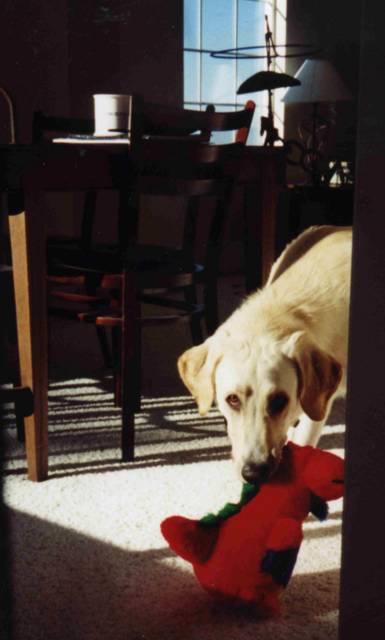
Our little Jackson was a gorgeous puppy who only got better looking as he grew up.

We took him to puppy pre-school at our local Petsmart. He won the best in class award, beating out Donny Osmond’s Black Lab. We were so focused on our little guy that it took us three classes before we finally realized that yes that was the guy from television in our obedience class with us. We considered the Osmond puppy unruly.

Like John Wesley Powell, Jackson led an adventurous life--flying on airplanes and traveling tens of thousands of miles in cars, mostly our 1997 Subaru. He went on ferry’s, slept on sail boats, went motor-boating, and camping. He was a willing and eager explorer, as long as someone was close by--usually me. We spent many many hours hiking, mountain biking, and cross-country skiing. He spent over three years of his life living on three different farms (including a ranch) where he roamed with total freedom.

Jackson called four states home for nine months or more. These were Utah, Ohio, Virginia, and Arizona. He also visited at least twenty other states and the District of Columbia, as well as Canada. The stupidest move of his life was when he nearly leaped into the rushing water at the top of Niagara Falls, a move that could have also taken me with him either accidentally as I was holding his leash, or in desperation to save him. We had just parked the Subaru and walked toward the noise of the falls, somewhat oblivious to our exact location. We approached a stone wall, and for a reason I will never understand Jackson leapt on top of this little wall which couldn’t have been more than six inches wide. On the other side was a twenty to thirty foot drop to the Niagara River, just before it plunges 170 feet. While I was unnerved by him nearly going into the cataract below, neither he nor I realized how close we were to the top of the falls until a few minutes after the incident.

As my friend Kevin Cromer observed, Jackson was regal and majestic. He seemed to know how good looking he was even though his real beauty came from within. Though he could be a little snooty with other dogs, he loved any person who was open to giving him a chance. With dogs he was usually the alpha. With people, he was putty, doing whatever it took to get attention and to give his love. Though once he was in command of his human handlers his independence became evident and he had a determined stubborn streak.

Through the force of his personality Jackson created a world that served his every need. Jackson and I were apart for a few extened periods--though I visited him during those separations. During the times we were apart, he was living it up on my Mom’s farm in Ohio. Even when we lived together he rallied a small army of people to serve him for the parts of the day or week when I wasn’t available. If he wasn’t outside on some mini-adventure, he loved to stay close to me. When I worked at my computer he often crammed himself under my desk so he could be as close as possible.

Jackson meant the world to me, providing an anchor to my peripatetic life. Living up to his role as the ideal dog, his devotion was complete. No matter where I went, or how often I packed everything up and moved, he happily came along (though the moves did unnerve him, about as much as they unnerved me).

He was smart, gorgeous, and loving. Mostly, he was an easy dog to be around and to take care of. Quiet over ninety-five percent of the time, he had a distinctive, loud bark that he employed anytime he thought he heard something. Though they say a dog’s hearing is much more sensitive than ours, I am convinced he had the tendency to bark at ghosts on occasion. But maybe he really did hear those ghosts . . . .

The end of his life came far too suddenly, as well as too soon. I am still reeling by the events of the final two days of his life. He died on October 25, 2004 in Phoenix after we discovered cancer was running rampant inside of him. He had just turned eight.

Jackson owns a piece of my heart. He also earned a place in the hearts of many others.

Thank you Jackson--we miss you.

Woof, woof!

Jim Breitinger
Phoenix, Arizona

PS--See photos below, and below those a timeline of Jackson's life.

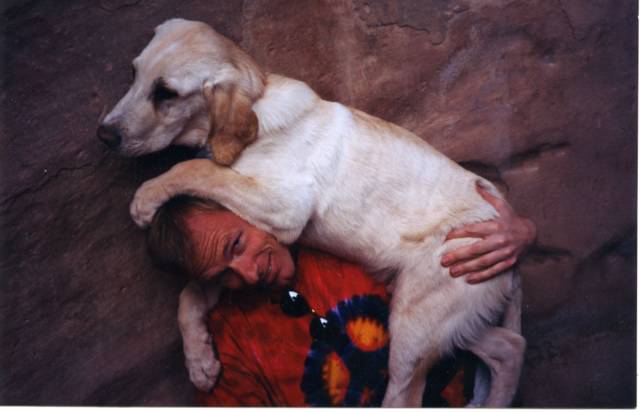
Bonded. (Photo by T. Alleman)

Soaking up some winter sun at Whiskey Creek Farm near the northern end of the Shenandoah Valley, December 2002. Posted by Hello

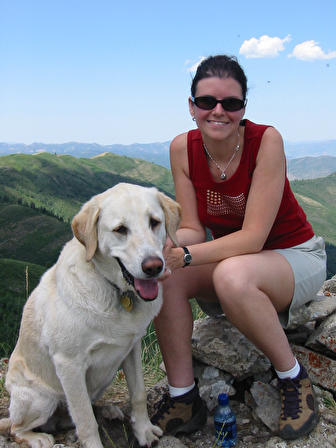
Hiking the Wasatch Mountains with Paula and Jim above Bear Hollow, near Park City, Utah, July 2002. Posted by Hello

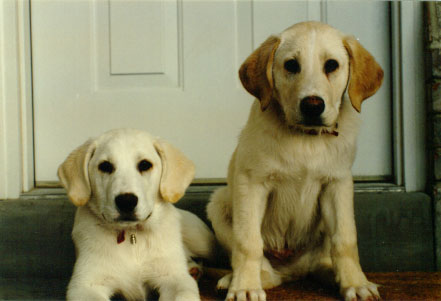
Jackson and his sister Andromeda (Andy) in Lindon, Utah, December 1996. Posted by Hello

Jackson at about six months of age--always willing to go wherever I took him. (Photo taken in southern Utah by P. Moreira).

Jackson and Barney.

Timeline and Settings of Jackson’s Life

October 16, 1996 Born
Young pup with his litter in Provo, Utah till Thanksgiving Day 1996

November 1996 to May 1998
Raised by Jim and David in Lindon, Utah
Many trips to southern Utah

May 1998 to August 1999
Fly (alone) to Ohio
Living it up at August Hill Farm, Lexington, Ohio

August 1999 to early May of 2001
Fly back to Utah--August '99
Urban living in Salt Lake City at the base of Utah’s Capitol Hill
First goes to Urban Dog (now Dog Mode) in August ‘99
City Creek Canyon and the Bonneville Trail
Intra-Utah travel
Three trips to Montana
First trip to California June/July 2000

May 2001
Drives east from Utah to Ohio via I-80
Layover in Ohio at August Hill Farm for five weeks
On to Virginia via PA Turnpike

June/July 2001
Reunited with Jim in Virginia, on the road till late July:
From Virginia to Dutchess County, New York and Windrock Farm
On to Canada along the old Erie Canal route across NY
Stop at Niagara Falls
Overnight in downtown Toronto
On to Mackinac Island, Michigan going north around Lake Huron
South to Ohio
West to Utah via St. Louis and Denver

July to October 2001
Living with Jim, at friend’s between Big and Little Cottonwood Canyons, Utah
Great hiking!
Side trip to San Francisco

Late October 2001 to December 15 2001
Jim and Jackson move to Barb’s in Summit Park, near Park City, Utah
Incredible hiking and running and rolling in the snow

December 15, 2001 to April 2002
Shipped off to Ohio again by plane--to August Hill Farm. Third extended visit in Ohio and second longest time away from Jim who was busy with the Olympics. Able to run free.

April to October 2002
Back with Jim, living at Barb's in Summit Park
In time for more cross country skiing before the snow melts
Lots of hiking in the mountains, woof!

Late October 2002
Drive east from Park City, Utah
Stops in Minneapolis, Mackinac Island, Ohio--Fox Hollow

November 2002 to August 1, 2003
Living in Berryville, Virginia
Life on the farm is kind of laid back

Early August 2003
Drive back to Utah
Stops in Ohio, Illinois (Doug, Nancy, Chopin and Co.), Colorado
Continue south from Utah to new home in Arizona

Mid-August 2003, to July 13, 2004
Roaming free at Beaver Creek Ranch
Trip to Utah (April ’04)
Tour the West: California, Oregon, Idaho, Utah (June ’04)

July 13 to October 25, 2004
Phoenix

Way too young to go!

Saturday, November 06, 2004

The End

Jackson’s life came to an abrupt end.

As late as Tuesday October 19 I didn’t notice any symptoms that he was sick. On Saturday, concerned because he wasn’t eating and wasn’t himself, I took him to the vet. Still, I wasn’t overly worried.

It turns out there was reason to be. They told me he had cancer. By the following Monday he was gone after an exploratory surgery confirmed the cancer and that it had already spread extensively.

The cards, emails, flowers, phone calls, etc. that I got from so many people after Jackson died made a huge difference for me. Thank you to everyone from me and in spirit—Jackson.

One of my favorite sentiments was from a relative in Flagstaff. She wrote “Someone once said that dogs' lives are shorter than humans because it takes a lifetime for people to learn how to love, dogs know from the beginning.”

My mother, who knew Jackson well, mirrored that sentiment. She said he was what we strive to be, a completely spiritually evolved being.

Everyone who saw Jackson and I together saw that we had a special bond. Some people didn’t necessarily understand it, I don’t know that I even understand it, but it was and is real.

Jim

In late 2002 Jackson and I moved to Summit Park near Park City, Utah. We rented part of a house from Barbara Felt, who also lived there with her daughter Megan. The following is from Barb:

The second week you were here, in the living room, you said "watch this. Jackson, go give Megan a kiss.” (Jackson got up and went right to Meg and gave her a big lick.)

“Now, Jackson, go shake Barbara’s hand." (He came straight to me with that huge paw outstretched).

We knew then that he was unusually humanlike.

Later there was that time when I took him running down the backside of Jeremy ranch on a leash that lasted about half the run, when he could not withhold any longer and decided if I was going to be on the other end of that leash, I was going in the river with him. I let go. He beamed.

Remember the day I though I’d lost him at the cabin on top? Well, he fooled me again. When you came to help rescue, there he was, waiting at the car.

Barb

Some more information I got from Steve, the guy we got Jackson from:

Jackson's mother was the daughter of two working sheep dogs who lived on a ranch somewhere in Utah. Her name is Oso, which means bear in Spanish. About a year ago she ran off during a storm and they were unable to find her, which was brutal for Steve and his family. Oso was terrified of loud noises and between the thunder and some fireworks that day she got scared and ran away. Despite an extensive search, they were unable to find her.

All of this explains a few things about Jackson. He loved to try to round up cars and trucks when he was roaming free on a ranch or farm. It was a strong instinct that was all but impossible to control. He also hated loud noises.

As far as Steve knew there are two siblings of Jackson's left in Provo, in the neighborhood where he was born. Their names are Cody and Sammy. We know of two other litter mates that were with their original [human] families for a year or less before moving on to other homes. We've lost track of them. Jackson's sister Andy died of cancer when she was still a pup.

On Jackson's second plane trip:

In a very generous offer, my friend Jim offered to fly me to Utah to visit him. Of course I accepted, willing to perform the deed required; I had to fly Jackson from Ohio to Salt Lake.

What a trip it was! Jackson and I drove to Cleveland. He had a very big crate. I gave him his sleepy drugs, kissed him on the nose, and off he went on the conveyor belt. I almost cried I was so worried about him travelling in the belly of the airplane. But off he went and I waited. And waited. And began watching the weather. Which got worse. And worse. And worse. Until finally my flight was cancelled. After much bantering with the clerks, they finally understood that I had to get Jackson out of baggage and back home until the next night, when it would be safe to fly. At last his crate appeared, but Jackson was at the height of sleepiness. He weighed a lot. It took every bit of strength I had, along with a helpful baggage handler, to get him out of the crate and into my pickup truck. He slept all the way home.

The next night the weather cleared and we were scheduled again. Fewer sleepy drugs (I had used most of them up the night before), crating, and waiting. I boarded the plane, making sure to get a seat where I could see the baggage being loaded. They wheeled Jackson out and I started to cry. Poor Jackson, directly down beneath me in with the baggage! Those droopy big brown eyes. I was a wreck and I started crying. I worried and fretted all the way to Salt Lake. Would he dehydrate? Would he have enough air? Would he feel sick and throw up? Was he being jostled or bumped?

None of the bad stuff happened and we made it to meet Jim. What a wonderful reunion for all three! The trip was awesome, with Jim showing me everything wonderful to be found in Salt Lake. A salty float in the lake after a wild thunderstorm had to be the highlight. Or maybe it was the hike among the aspens up on the mountain, with Jackson leading the way. Or walking through the downtown dog park with Jackson off the leash. The whole trip was absolutely amazing! Thank you Jim, and thank you Jackson.

Marijan Grogoza

[I never drugged Jackson again on his future plane trips. -JB]

If you have any good Jackson stories, please send me an email at utahredrock at yahoo.com

Monday, August 23, 2004

The Orchids of Arizona

Orchids growing in Arizona? And in the wild? This seemed like a fantastic concept to me, so I spent some time checking into it further.

Last week I drove north from Phoenix and the Valley of the Heat to meet up with my friend Mike Currie, a graduate student in botany at Northern Arizona University (NAU) in Flagstaff. I’d been bugging him to go on an orchid collecting trip for a few months, and we finally found a time that worked for both of us.

From Flagstaff we continued northeast to the Navajo Nation and specifically to Navajo National Monument, an enclave administered by the United States Park Service within the Navajo reservation. The monument was a revelation for me. I’ve made dozens of trips to the canyon country of the Colorado Plateau and consider it to be one of my favorite places on earth. It is so special in part because it is so full of surprises. When you explore the canyon country you quickly discover there is much more to it than you initially imagined.

Navajo National Monument exists primarily to preserve ancient cliff dwellings of the people know as the Anasazi by the Navajo. The Navajo themselves are relative late comers (1500s) to the area, pushing out the Hopi Indians, who are believed to have descended from the cliff dwellers who built the seven hundred year old ruins that remain today.

While the cliff dwellings were magnificent, what really got my attention were Betatakin Canyon and its flora in the heart of the monument. Here there are fir trees and aspens amidst a desert ecosystem dominated by the more familiar junipers and pinions. The firs are especially magnificent. The overall population of fir trees is small, but some of them are giants in diameter. They are similar to what you would see in redwood forests--trees whose girths are simply astounding. The quaking aspens cast their magical spell over the canyon which at 7,000 feet remains cool enough for these trees to survive. After weeks in the heat of Phoenix, I’d arrived in paradise.

Firs and aspens amidst juniper and pinyon trees in a redrock canyon of the Colorado Plateau! This region never ceases to amaze.

And what about those orchids? Betatakin Canyon is home to two of Arizona’s thirty-some species of orchids. My trip leader, botanist Mike Currie, set about examining, documenting, and collecting cuttings from the endangered alcove bog orchid that he is studying for his graduate work at NAU. Once I calmed down after the surprise of seeing aspens and firs, I let Mike show me his orchids.

While he was thrilled after discovering the largest population of bog orchids he had ever observed, I couldn’t help but state that these orchids were a little disappointing. They are not nearly as showy as some of their more famous cousins. Their flowers looked more like a miniature version of the spiky flower of a yucca, then what I’d come to think of as the flashy orchid. My previous exposure to orchids came on a trip in the Ecuadorian Amazon where large showy orchids grew along the roads and rivers in abundance. Mike gave me a tutorial on the wide variety of orchids and was undeterred by my reaction. The other orchid of Betatakin Canyon, the stream orchid, is much showier. Another Arizona orchid is the fairy slipper orchid found in the San Francisco Peaks which is showy enough that it is sold commercially. But we came to see the humble bog orchid, which showy are not, was still an orchid.

In 1986 Larry Higgens and Stan Welsh, two Utah botanists, classified the bog orchids, which are only found in the American Southwest, into two species: alpine and alcove. Mike believes they are actually one species and proving this is the thrust of his study. An important part of his work involves genetic research. He will be extracting DNA from the leaf cuttings and comparing the genetic code to other cuttings he’s gathered from different populations, as well as the alpine bog orchid, in his effort to see whether or not there is a difference between the two bog orchids. His work is also part of a broader genetics study of the evolutionary relationships between species. Mike is the final student to earn a bachelors degree in botany from NAU due to budget cutbacks.

So yes, Arizona does have orchids which are not just limited to the tropics--they even grow in the harsh deserts and mountains of the American Southwest including the ever surprising Colorado Plateau region. It was refreshing to see a native Arizonan who’d discovered a passion for orchids while studying at NAU. In the great American tradition, he’s scraping by while he follows his passion and at the same time advances our knowledge about the world we live in.

Thursday, July 29, 2004


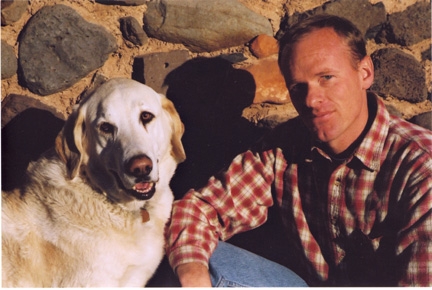
Jim and Jackson, Beaver Creek Ranch, December 2003 (Photo by T. Alleman)

Wednesday, July 28, 2004

Adventures with Pigs

“You pigs are getting too close! Go away!!” I said two nights ago at about 11 PM. 
 
My friend Nate and I were beginning our three day adventure on Santa Cruz Island, part of the Channel Islands, and Channel Islands National Park. We departed the mainland at Ventura, California an hour north of Los Angeles. 

The excitement began on the ferry ride over. We rode in a “high-speed” catamaran which went about 25 MPH over the surface of the Pacific (not sure how many knots that is). Our first sighting of interest was a group of sea lions on a buoy at the harbor exit. En route to the island, the viewing got much better. 
 
We began to see dolphins and our captain slowed the ferry to give us a better view. Before we knew it we were surrounded by dozens of these playful mammals of the sea. When we picked up speed again they raced off our bow, where some of us were standing. Just below my feet, the cousins of Flipper were cruising at high speed, coming up for air every 20-30 seconds and giving us quite a show. 
 
After an hour at sea, we arrived at Santa Cruz Island. There to meet us was Ranger Dan, United States Park Service. 
 
“Welcome to Santa Cruz Island,” he said in his welcoming speech. Just before this he called my friend Nate “buddy” in the tone of voice a ranger might use when speaking to a twelve year old. Ranger Dan was younger than Nate, by what looked like about ten years. Nate was offended by the greeting. 
 
“One thing you’ll notice as you’re going to sleep tonight is a lot of noise, and if you have a light you will see the source. We have thousands of wild pigs here on the island. They are a legacy of the ranching days, and they will come right in to camp. They won’t hurt you, but make sure you keep all of your food in the storage bins we provide. If the pigs don’t get it, the mice will. The ground around here literally moves at night.” 
 
After informing us of the dangers of hantavirus, a frequently fatal respiratory disease spread by mouse feces (it is also rarely contracted), Ranger Dan had our attention regarding the pigs and the mice. 
 
This end of the island is known as Scorpion Ranch (apparently they have scorpions too). The Scorpion Ranch area is equipped to handle the most visitors of any site on Santa Cruz Island, up to 250 campers. We had something less than a third of that number, with fewer than twenty people in the Upper Campground where we set up our base. The entire island is 62,000 acres--about three times the size of Manhattan. 
 
After Ranger Dan’s speech, which was quite elaborate as well as corny in a way that only a Park Service ranger can be, we dropped our gear at our campsite and prepared for our first sea kayaking adventure. We got a screaming deal on a two man sea kayak just before boarding the ferry. 
 
Nate and I headed out to sea, he with his digital camera and no waterproof bag. This would be the shorter of our two sea kayaking tours. It was a great introduction. Though there are some rocky beaches, the ocean meets most of the island where the land jutsstraight up, rising up to 1,000 feet along most of the coastline. The effect is spectacular. We in our sea kayak at the base of this mountain rising out of the sea felt small and vulnerable against the power of the ocean and the mass of the island next to us.  
 
We explored one or two sea caves, floating into dark spaces on our kayak. As we paddled along the coastline, we came to a point and continued on. Around the point the waves were much bigger and it was windier. We turned back. A few minutes later we ran in to a man and his son and said hello. He asked if we had been around the nearby point, telling us there were wonderful sea caves just on the other side. 
 
Bravely, or stupidly, we followed them. We got wet the first time, but this time we were in the big waves longer. We would paddle over the crest of a wave, plunge down the other side, and at least every fourth wave would break over the kayak. Since Nate was in front, he got soaked. His camera was a casualty of this adventure. 
 
We hiked that afternoon, met a couple named Ben and Julie, ate some food and by 7:30, with about ninety minutes of daylight left, we both fell asleep.   
 
We planned to be backpacking, so we brought the minimal amount of gear. Both of us were sleeping under the stars (and you could see the stars! The lights of LA were too far away to affect the night view). I was on my Mega-rest air mattress by Thermarest. Nate just slept on the ground--in a sleeping bag. Shortly after dark the invasion of the wild pigs began. 
 
These guys came within ten feet of us. They had a feast eating the grass, and who knows what else, just around our camp. We were both exhausted, but the pigs woke us and got our attention. There was some grunting just beyond Nate. I was convinced that he was just messing with me, but eventually realized he wasn’t. The sound was very close. After a few minutes of pig observing, we both fell back to sleep. The rest of the night I would occasionally be startled awake by the sound of some 300 pound creature that was way too close. Yet after yelling at the pigs to “go away,” I always fell asleep again in a short amount of time. They never did follow my commands, even though they are supposed to be smart. 
 
The next morning we rose with the sun, ate, and headed back out to sea. This time we were out for about three hours in the kayak. The ocean was calmer. We saw some sea lions, or seals--not sure what the proper nomenclature is. The tide was much lower than when we went out the day before. The lower water level revealed thousands of starfish, clinging to the rocky side of the island’s waterline where its rocky sides meet the Pacific. The most memorable thing was the many sea caves. 
 
We’d paddle back in to the darkness of one cave after another. While the ocean was calmer than the day before, it still had its normal waves with the occasionally larger than normal swell. When a big wave came in to a cave, it would push us up toward the rocky ceiling, and scare the crap out of us as we were treated like a cork in a container of water--with the cave being the container. At one point we were at least 350 feet back in a long narrow cave. It was spooky, but very cool. 
 
After kayaking and lunch we headed out for a hike. The island is very mountainous, with its highest point rising over 2,000 feet above the ocean, so the hike was a good workout. At the beginning of our hike we happened across Ben and Julie, who we’d met the night before (and who were not a couple, or so they said). Along with them was a group of three guys that they met in camp--Warren, Chad, and Tim. We were to become the Santa Cruz Seven. For the next 24 plus hours we all hung out together.  
 
The hike was fantastic. We were up in the fog covered mountains. The fog burned off before our descent, providing stunning views of the ocean around us. That section of the island was about two miles in width. We bushwhacked around looking for pigs. I never saw one during the day (where do they go??) but Nate, Julie, and Ben had a close encounter with a 300 hundred pounder. The landscape reminded me of the paramo ecosystem in the Andes. The Channel Islands are very dry most of the time, but not as dry as Arizona, and cooler as well, so the flora had a very different look about it. 
 
Tim, Chad, and Warren hosted a dinner party in camp that lived up to its billing. They fed us salmon, salad, and more. Nate and I just had backpacking food with us, so this was a major treat. We stayed up talking for hours, until everyone faded, which probably wasn’t that late. Once the sun goes down, and without electricity, you tend to go to sleep earlier.  
 
The last day on the island was more relaxed. We split up in to smaller groups and did various short hikes. Nate and I arrived back at his apartment in Pasadena around 7 PM, exhausted again. Nikki made a great dinner and we crashed. She took care of Jackson while we went on our island adventure and Jackson was perfectly content under her care. 
 
The next morning Jackson and I left, heading north through California’s Central Valley--the most productive agricultural region in the world and one of the wonders of 20th century technology and ingenuity conquering nature.  
 
Regards, 
 
Jim
Written in Pasadena and Portland
Sent from Salt Lake City
And entered as my first blog from my new home in Phoenix a couple weeks later

Friday, July 02, 2004

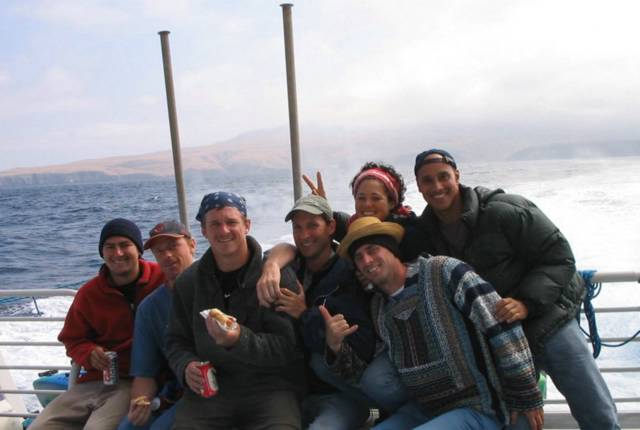
Photo of Santa Cruz Seven


The Santa Cruz Seven, en route back to Ventura, California (double click on photo for a larger/clearer view) Posted by Hello


Thursday, June 17, 2004

Perfectly Exquisite

Ahhhh, to be a denizen of the twenty-first century.
 
With my new sound system installed in my Subaru, I headed up the freeway this evening from Phoenix--coming back to my soon to be former haven on Beaver Creek.
 
The freeway! That mid-twentieth century creation that seems so pedestrian, yet is so revolutionary. It cuts its well graded, well designed way through the deserts and mountains of Arizona, making eighty mile an hour travel a breeze while climbing thousands of feet through treacherous terrain. The route from Phoenix toBeaver Creek Ranch is now an easy one. As recently as thirty to forty years ago, the same journey would have taken many times as long--dominated by less direct highways and more miles of dirt roads (only the final mile remains unpaved, thank God!).
 
The sound system! Not only did I upgrade from the analog technology of cassette tapes to the digital technology of compact discs, I also became an adopterof that twenty-first century innovation: satellite radio. With 110 stations available no matter where I travel, including up the canyons of Beaver Creek (as well as far more remote areas), the programming that is available is astounding. The program mixes “fed” to me by my satellite provider--Sirius--were outstanding. I chose Sirius over their competitor XM Radio, because they provide NPR as one of their feeds. I guess this means I really am a liberal! (Oh brother.)
 
And the wilds! About halfway between the metropolis ofPhoenix, and my remote ranch on Beaver Creek, right on the interstate freeway, a large mountain lion ran in front of me. Even with our fancy roads and sound systems, wild America lingers on. The cat was huge and graceful.
 
As I prepare for an all too brief, slightly less than three week tour of the West Coast, I am reconnecting to the grid via satellite and cell phone. No more remote Arizona ranch life for me. I move to Phoenix on July 12, unemployed and looking for work. 
 
Regards,
 
Jim and Jackson
At Beaver Creek Ranch under intense starshine
10 PM
June 17, 2004